Association of Left Atrial Coupling Index with Infarction Site and Cardiac Biomarkers in Patients with First Episode of Acute Myocardial Infarction
DOI:
https://doi.org/10.54133/ajms.v10i2.2873الكلمات المفتاحية:
Acute Myocardial Infarction، Echocardiography، Left Atrial Coupling Index، NT-proBNP، Troponinالملخص
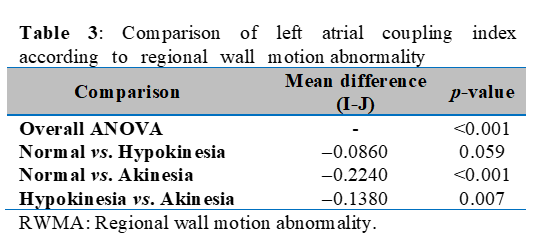
Background: Acute myocardial infarction leads to elevation of left ventricular pressure, which is transmitted to the left atrium, resulting in changes in left atrial volume and function. LACI is a novel echocardiographic parameter that reflects the left atrioventricular interaction and may provide insight into infarction size and early risk stratification. Objectives: To evaluate LACI and its association with infarction site and cardiac biomarkers, including troponin and N-terminal pro-B-type natriuretic peptide (NT-proBNP), in patients experiencing a first episode of acute myocardial infarction. Methods: This cross-sectional study enrolled forty-two patients with the first episode of acute myocardial infarction. Peak serum troponin and NT-proBNP were recorded for each patient. Transthoracic echocardiography was performed to assess regional wall motion abnormality, left ventricular ejection fraction, and LACI, which was calculated as the ratio of left atrial end-diastolic volume to left ventricular end-diastolic volume. Results: The mean LACI was 0.46±0.13, with significantly higher LACI values observed in patients with anterior myocardial infarction compared to inferior or lateral infarctions. LACI shows a positive correlation with troponin and NT-proBNP and was inversely associated with LV ejection fraction. Higher values were noted in patients with severe regional motion abnormality, particularly akinesia. Receiver operating characteristic (ROC) analysis demonstrated a moderate discriminatory ability for identifying patients with higher levels of cardiac biomarkers. Conclusions: LACI may reflect the infarction severity and ventricular dysfunction and could serve as a useful noninvasive tool for risk stratification and assessment of hemodynamic burden.
التنزيلات
المراجع
Tang Y, Peng S, Yao HL, Liu Z, Zhang L, Zhong C, et al. Left atrial function index predicts poor outcomes in acute myocardial infarction patients treated with percutaneous coronary intervention. Front Cardiovasc Med. 2023;10:1043775. doi: 10.3389/fcvm.2023.1043775.
Sia CH, Ko J, Zheng H, Ho AF, Foo LL, Foo D, et al. Comparison of mortality outcomes in acute myocardial infarction patients with or without standard modifiable cardiovascular risk factors. Front Cardiovasc Med. 2022;9:876465. doi: 10.3389/fcvm.2022.876465.
Prasad SB, Guppy-Coles K, Stanton T, Armstrong J, Krishnaswamy R, Whalley G, et al. Relation of left atrial volumes in patients with myocardial infarction to left ventricular filling pressures and outcomes. Am J Cardiol. 2019;124(3):325–333. doi: 10.1016/j.amjcard.2019.05.007.
Tangen J, Nguyen TM, Melichova D, Klaeboe LG, Forsa M, Andresen K, et al. Left atrial volume assessed by echocardiography identifies patients with high risk of adverseoutcome after acute myocardial infarction. Echo Res Pract. 2024;11(1):24. doi: 10.1186/s44156-024-00060-1.
Durmaz E, Karpuz MH, İkitimur B, Karadag B, Koca D, Ohtaroglu Tokdil K, et al. The validation of left atrial strain imaging for the assessment of diastolic functions in patients with ST-segment elevation myocardial infarction. Int J Cardiovasc Imaging. 2022;38(10):2109–2114. doi: 10.1007/s10554-022-02628-6.
Malagoli A, Tondi S, Torlai Triglia L, Cameli M, Guerra F, Benfari G. Left atrial function predicts early adverse outcomes in patients with acute myocardial infarction. J Cardiovasc Med (Hagerstown). 2023;24(2):138–140. doi: 10.2459/JCM.000000000000140.
Pezel T, Ambale Venkatesh B, Kato Y, De Vasconcellos HD, Heckbert SR, Wu CO, et al. Left atrioventricular coupling index to predict incident heart failure: The Multi-Ethnic Study of Atherosclerosis. Front Cardiovasc Med. 2021;8:704611. doi: 10.3389/fcvm.2021.704611.
Nguyen Ngoc Dang H, Viet Luong T, Khanh Tran H, Ha Tuyet Le N, Hoang Nhat Nguyen M, Chi Doan T, et al. Left atrioventricular coupling index measured by echocardiography in heart failure with preserved ejection fraction. Sci Rep. 2025;15(1):20419. doi: 10.1038/s41598-025-06291-4.
Vidula MK, Chirinos JA. Left atrial coupling index and its prognostic value in heart failure with reduced ejection fraction. Circ Cardiovasc Imaging. 2021;14(1):e012221. doi: 10.1161/CIRCIMAGING.120.012221.
Fortuni F, Biagioli P, Myagmardorj R, Mengoni A, Chua AP, Zuchi C, et al. Left atrioventricular coupling index: A novel diastolic parameter to refine prognosis in heart failure. J Am Soc Echocardiogr. 2024;37(11):1038–1046. doi: 10.1016/j.echo.2024.06.013.
Di Chiara A, Dall'Armellina E, Badano LP, Meduri S, Pezzutto N, Fioretti PM. Predictive value of cardiac troponin-I compared to creatine kinase-myocardial band for the assessment of infarct size as measured by cardiac magnetic resonance. J Cardiovasc Med (Hagerstown). 2010;11(8):587–592. doi: 10.2459/JCM.0b013e3283383153.
Assadi H, Matthews G, Chambers B, Grafton-Clarke C, Shabi M, Plein S, et al. Cardiac magnetic resonance left ventricular filling pressure is associated with NT-proBNP in patients with new onset heart failure. Medicina (Kaunas). 2023;59(11):1924. doi: 10.3390/medicina59111924.
Thygesen K, Alpert JS, Jaffe AS, Chaitman BR, Bax JJ, Morrow DA, et al; Executive Group on behalf of the Joint European Society of Cardiology (ESC)/American College of Cardiology (ACC)/American Heart Association (AHA)/World Heart Federation (WHF) Task Force for the Universal Definition of Myocardial Infarction. Fourth universal definition of myocardial infarction (2018). Circulation. 2018;138(20):e618–e651. doi: 10.1161/CIR.0000000000000617.
Lang RM, Badano LP, Mor-Avi V, Afilalo J, Armstrong A, Ernande L, et al. Recommendations for cardiac chamber quantification by echocardiography in adults: An update from the American Society of Echocardiography and the European Association of Cardiovascular Imaging. J Am Soc Echocardiogr. 2015;28(1):1–39. doi: 10.1016/j.echo.2014.10.003.
Wu JP, Zhao Y, Gu XY, Chen BH, Wu R, Andong AL, et al. Atrioventricular coupling index: A novel approach to risk-stratification for major adverse cardiovascular events in patients with ST-elevation myocardial infarction. J Magn Reson Imaging. 2026;63(1):235–248. doi: 10.1002/jmri.70088.
Hallén J. Troponin for the estimation of infarct size: what have we learned? Cardiology. 2012;121(3):204–212. doi: 10.1159/000337113.
Almeida I, Chin J, Santos H, Miranda H, Santos M, Sá C, et al. Prognostic value of brain natriuretic peptide in ST-elevation myocardial infarction patients: A Portuguese registry. Rev Port Cardiol. 2022;41(2):87–95. doi: 10.1016/j.repc.2020.12.016.
Lee JW, Choi E, Khanam SS, Son JW, Youn YJ, Ahn MS, et al. Prognostic value of short-term follow-up B-type natriuretic peptide levels after hospital discharge in patients with acute myocardial infarction. Int J Cardiol. 2019;289:19–23. doi: 10.1016/j.ijcard.2019.01.026.
Del Buono MG, Crea F, Indolfi C. Clinical predictors and prognostic role of high Killip class in patients presenting with anterior ST-elevation myocardial infarction due to proximal or mid left anterior descending artery. J Cardiovasc Med (Hagerstown). 2021;22(5):337–345. doi: 10.2459/JCM.0000000000001168.
Kyhl K, Vejlstrup N, Lønborg J, Treiman M, Ahtarovski KA, Helqvist S, et al. Predictors and prognostic value of left atrial remodelling after acute myocardial infarction. Open Heart. 2015;2:e000223. doi: 10.1136/openhrt-2014-000223.
Espersen C, Modin D, Platz E, Jensen GB, Schnohr P, Prescott E, et al. Global and regional wall motion abnormalities and incident heart failure in the general population. Int J Cardiol. 2022;357:146–151. doi: 10.1016/j.ijcard.2022.03.027.
Zhu RY, Hu HT, Zhang AY, Shen D, Hu WS, Li XY, et al. Predictive value of left atrial coupling index applied to real-time three-dimensional echocardiography for late recurrence after ablation in patients with paroxysmal atrial fibrillation. Echocardiography. 2025;42(11):e70342. doi: 10.1111/echo.70342
التنزيلات
منشور
كيفية الاقتباس
إصدار
القسم
الرخصة
الحقوق الفكرية (c) 2026 Al-Rafidain Journal of Medical Sciences

هذا العمل مرخص بموجب Creative Commons Attribution-NonCommercial-ShareAlike 4.0 International License.
Published by Al-Rafidain University College. This is an open access journal issued under the CC BY-NC-SA 4.0 license (https://creativecommons.org/licenses/by-nc-sa/4.0/).