Acute Remote Ischemic Preconditioning Alters Autonomic Function, Corrected Left Ventricular Ejection Time, and Pulse Transit Time in Healthy Adults
DOI:
https://doi.org/10.54133/ajms.v10i2.2925الكلمات المفتاحية:
Corrected left ventricular ejection time ، Heart rate variability ، Pulse transit time ، Remote ischemic preconditioningالملخص
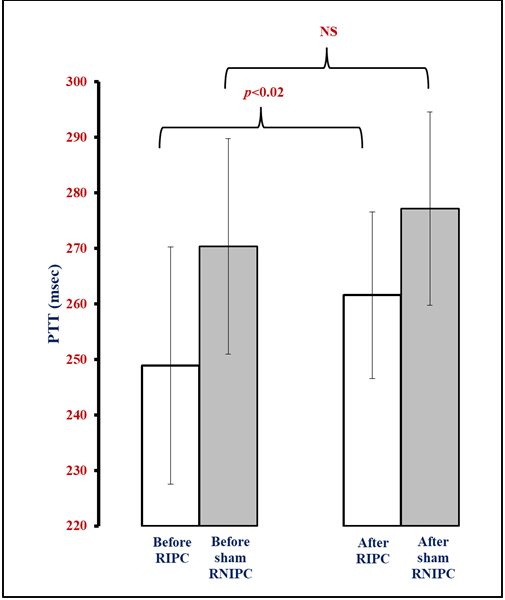
Background: Remote ischemic preconditioning (RIPC) leads to systemic protective responses via neural, hormonal, and endothelial pathways, with autonomic modulation as a key mediator. While most studies focus on heart rate variability (HRV) and arterial stiffness, limited data exist on RIPC’s acute effects on cardiac systolic timing and vascular pulse conduction. Objective: To investigate the acute effects of RIPC on autonomic function, heart rate-corrected left ventricular ejection time (cLVET), and pulse transit time (PTT) in healthy adults. Methods: Fifteen healthy young men completed RIPC and sham RNIPC protocols. RIPC involved four 5-min cycles of upper-arm cuff inflation to 230 mmHg followed by 5-min deflation; sham used 30 mmHg. Continuous ECG and digital pulse wave recordings were obtained before and after each intervention. HRV indices, PTT, PWV, and cLVET were derived from ECG-gated waveform analysis. Results: Following RIPC, mean RR interval, SD1, pNN50, high-frequency power, and SD2 increased significantly, while systolic blood pressure decreased. PTT increased significantly, with a corresponding reduction in calculated PWV. In addition, cLVET decreased significantly after RIPC. In the sham RNIPC condition, no significant changes were observed in HRV indices, PTT/PWV, or cLVET, although systolic blood pressure also declined significantly. Conclusions: Acute RIPC induced coordinated changes in autonomic and cardiovascular timing, including enhanced vagal HRV, prolonged PTT, reduced PWV, and shortened cLVET, suggesting cLVET and PTT as useful markers for short-term autonomic–cardiovascular responses in healthy adults.
التنزيلات
المراجع
Ganji N, Biouuss G, Sabbatini S, Li B, Lee C, Pierro A. Remote ischemic conditioning in necrotizing enterocolitis. Semin Pediatr Surg. 2023;32(3):151312. doi: 10.1016/j.sempedsurg.2023.151312. DOI: https://doi.org/10.1016/j.sempedsurg.2023.151312
Hausenloy DJ, Yellon DM. Remote ischaemic preconditioning: underlying mechanisms and clinical application. Cardiovasc Res. 2008;79(3):377-386. doi: 10.1093/cvr/cvn114. DOI: https://doi.org/10.1093/cvr/cvn114
Loukogeorgakis SP, Panagiotidou AT, Broadhead MW, Donald A, Deanfield JE, MacAllister RJ. Remote ischemic preconditioning provides early and late protection against endothelial ischemia‑reperfusion injury in humans: role of the autonomic nervous system. J Am Coll Cardiol. 2005;46(3):450–456. doi: 10.1016/j.jacc.2005.04.044. DOI: https://doi.org/10.1016/j.jacc.2005.04.044
Aulakh AS, Randhawa PK, Singh N, Jaggi AS. Neurogenic pathways in remote ischemic preconditioning induced cardioprotection: Evidences and possible mechanisms. Korean J Physiol Pharmacol. 2017;21(2):145–152. doi: 10.4196/kjpp.2017.21.2.145. DOI: https://doi.org/10.4196/kjpp.2017.21.2.145
Gardner RN, Sabino-Carvalho JL, Kim J, Vianna LC, Lang JA. Two weeks of remote ischaemic preconditioning alters sympathovagal balance in healthy humans. Exp Physiol. 2020;105(9):1500-1506. doi: 10.1113/EP088789. DOI: https://doi.org/10.1113/EP088789
Alhakak AS, Teerlink JR, Lindenfeld J, Böhm M, Rosano GMC, Biering‑Sørensen T. The significance of left ventricular ejection time in heart failure with reduced ejection fraction. Eur J Heart Fail. 2021;23(4):541‑551. doi: 10.1002/ejhf.2125. DOI: https://doi.org/10.1002/ejhf.2125
Wiley CR, Pourmand V, Thayer JF, Williams DP. A close examination of the use of systolic time intervals in the calculation of impedance‑derived cardiac autonomic balance and regulation. Front Neurosci. 2021;15:625276. doi: 10.3389/fnins.2021.625276. DOI: https://doi.org/10.3389/fnins.2021.625276
Evdochim L, Dobrescu D, Dobrescu L, Stanciu S, Halichidis S. Left ventricular ejection time estimation from blood pressure and photoplethysmography signals based on tidal wave. Appl Sci. 2023;13(19):11025. doi: 10.3390/app131911025. DOI: https://doi.org/10.3390/app131911025
Block RC, Yavarimanesh M, Natarajan K, Carek A, Mousavi A, Chandrasekhar A, et al. Conventional pulse transit times as markers of blood pressure changes in humans. Sci Rep. 2020;10:16373. doi: 10.1038/s41598‑020‑73143‑8. DOI: https://doi.org/10.1038/s41598-020-73143-8
Mukkamala R, Hahn JO, Inan OT, Mestha LK, Kim C‑S, Töreyin H, et al. Toward ubiquitous blood pressure monitoring via pulse transit time: theory and practice. IEEE Trans Biomed Eng. 2015;62(8):1879–1901. doi: 10.1109/TBME.2015.2441951. DOI: https://doi.org/10.1109/TBME.2015.2441951
Bridges J, Shishavan HH, Salmon A, Metersky M, Kim I. Exploring the potential of pulse transit time as a biomarker for sleep efficiency through a comparison analysis with heart rate and heart rate variability. Sensors (Basel). 2023;23(11):5112. doi: 10.3390/s23115112. DOI: https://doi.org/10.3390/s23115112
Eerik K, Kasepalu T, Post H, Eha J, Kals M, Björck M, et al. Effects of repeated remote ischaemic preconditioning on arterial stiffness, organ damage, and oxidative stress in patients with intermittent claudication: a sham‑controlled randomised trial. Eur J Vasc Endovasc Surg. 2026;71(1):117–123. doi: 10.1016/j.ejvs.2025.06.046. DOI: https://doi.org/10.1016/j.ejvs.2025.06.046
Lang JA, Kim J. Remote ischaemic preconditioning – translating cardiovascular benefits to humans. J Physiol. 2022;600(13):3053–3067. doi: 10.1113/JP282568. DOI: https://doi.org/10.1113/JP282568
Müller J, Taebling M, Oberhoffer R. Remote ischemic preconditioning has no short term effect on blood pressure, heart rate, and arterial stiffness in healthy young adults. Front Physiol. 2019;10:1094. doi: 10.3389/fphys.2019.01094. DOI: https://doi.org/10.3389/fphys.2019.01094
Heinen A, Behmenburg F, Aytulun A, Dierkes M, Zerbin L, Kaisers W, et al. The release of cardioprotective humoral factors after remote ischemic preconditioning in humans is age- and sex-dependent. J Transl Med. 2018;16(1):112. doi: 10.1186/s12967-018-1480-0. DOI: https://doi.org/10.1186/s12967-018-1480-0
Incognito AV, Doherty CJ, Lee JB, Burns MJ, Millar PJ. Ischemic preconditioning does not alter muscle sympathetic responses to static handgrip and metaboreflex activation in young healthy men. Physiol Rep. 2017;5(14):e13342. doi: 10.14814/phy2.13342. DOI: https://doi.org/10.14814/phy2.13342
Slušnienė A, Laucevičius A, Navickas P, Ryliškytė L, Stankus V, Stankus A, et al. Daily heart rate variability indices in subjects with and without metabolic syndrome before and after the elimination of the influence of day‑time physical activity. Medicina (Kaunas). 2019;55(10):700. doi: 10.3390/medicina55100700. DOI: https://doi.org/10.3390/medicina55100700
Adnan SK, Neda FS, Al-Gailani BT. Vascular stiffness in cold pressor test hyper-reactors. Pol J Med Phys Eng. 2023;29(3):151–155. doi: 10.2478/pjmpe-2023-0023. DOI: https://doi.org/10.2478/pjmpe-2023-0016
Gesche H, Grosskurth D, Küchler G, Patzak A. Continuous blood pressure measurement by using the pulse transit time: comparison to a cuff-based method. Eur J Appl Physiol. 2012;112(1):309-315. doi: 10.1007/s00421-011-1983-3. DOI: https://doi.org/10.1007/s00421-011-1983-3
Saleem AF, Al-Wahab ZN, Al-Gailani BT. Effect of acupuncture at Shaofu acupoint on the cardiovascular system of healthy individuals. Pol J Med Phys Eng. 2024;30(3):127-130. doi: 10.2478/pjmpe-2024-0014. DOI: https://doi.org/10.2478/pjmpe-2024-0015
van Houte J, Eerdekens R, Manning F, Te Pas M, Houterman S, Wijnbergen I, et al. Is the corrected carotid flow time a clinically acceptable surrogate hemodynamic parameter for the left ventricular ejection time? Ultrasound Med Biol. 2024;50(4):528-535. doi: 10.1016/j.ultrasmedbio.2023.12.013. DOI: https://doi.org/10.1016/j.ultrasmedbio.2023.12.013
Meybohm P, Kohlhaas M, Stoppe C, Gruenewald M, Renner J, Bein B, et al. RIPHeart (Remote Ischemic Preconditioning for Heart Surgery) Study Collaborators. RIPHeart (Remote Ischemic Preconditioning for Heart Surgery) Study: myocardial dysfunction, postoperative neurocognitive dysfunction, and 1 year follow-up. J Am Heart Assoc. 2018;7(7):e008077. doi: 10.1161/JAHA.117.008077. DOI: https://doi.org/10.1161/JAHA.117.008077
Salvi P, Palombo C, Salvi GM, Labat C, Parati G, Benetos A. Left ventricular ejection time, not heart rate, is an independent correlate of aortic pulse wave velocity. J Appl Physiol (1985). 2013;115(11):1610-1617. doi: 10.1152/japplphysiol.00475.2013. DOI: https://doi.org/10.1152/japplphysiol.00475.2013
Michael S, Graham KS, Davis GM. Cardiac autonomic responses during exercise and post-exercise recovery using heart rate variability and systolic time intervals-a review. Front Physiol. 2017;8:301. doi: 10.3389/fphys.2017.00301. DOI: https://doi.org/10.3389/fphys.2017.00301
Hadaya J, Ardell JL. Autonomic modulation for cardiovascular disease. Front Physiol. 2020;11:617459. doi: 10.3389/fphys.2020.617459. DOI: https://doi.org/10.3389/fphys.2020.617459
Onegbu N, Kamran H, Sharma B, Bapat M, Littman S, Warrier N, et al. The effects of ischemia with and without remote conditioning on hyperemia induced decline in carotid‑radial pulse wave velocity. Atherosclerosis. 2012;220(1):150-156. doi: 10.1016/j.atherosclerosis.2011.10.028. DOI: https://doi.org/10.1016/j.atherosclerosis.2011.10.028
Ghimire M, Sanchez BK, Kim J. Repetitive remote ischemic preconditioning as a potential alternative intervention to attenuate arterial stiffness in individuals with elevated blood pressure. Am J Physiol Heart Circ Physiol. 2025;329(1):H172–H177. doi: 10.1152/ajpheart.00299.2025. DOI: https://doi.org/10.1152/ajpheart.00299.2025
Holwerda SW, Luehrs RE, DuBose L, Collins MT, Wooldridge NA, Stroud AK, et al. Elevated muscle sympathetic nerve activity contributes to central artery stiffness in young and middle-age/older adults. Hypertension. 2019;73(5):1025-1035. doi: 10.1161/HYPERTENSIONAHA.118.12462. DOI: https://doi.org/10.1161/HYPERTENSIONAHA.118.12462
Fok H, Jiang B, Clapp B, Chowienczyk P. Selective effects of nitric oxide donors to dilate muscular arteries relative to resistance vessels: regulation of vascular tone and pulse wave velocity in human muscular conduit arteries. Hypertension. 2012;60(5):1220-1225. doi: 10.1161/HYPERTENSIONAHA.112.198788. DOI: https://doi.org/10.1161/HYPERTENSIONAHA.112.198788
التنزيلات
منشور
كيفية الاقتباس
إصدار
القسم
الرخصة
الحقوق الفكرية (c) 2026 Al-Rafidain Journal of Medical Sciences

هذا العمل مرخص بموجب Creative Commons Attribution-NonCommercial-ShareAlike 4.0 International License.
Published by Al-Rafidain University College. This is an open access journal issued under the CC BY-NC-SA 4.0 license (https://creativecommons.org/licenses/by-nc-sa/4.0/).