Analysis of Prostate-Specific Antigen Levels in a Population-Based Prostate Cancer Screening Program at Hiwa Hospital, Sulaymaniyah, Iraq
DOI:
https://doi.org/10.54133/ajms.v11i1.3130Keywords:
Cancer, Prostate, Population, PSA, ScreeningAbstract
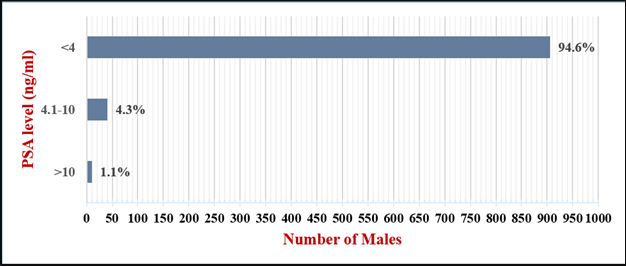
Background: Prostate cancer is the third most frequently diagnosed cancer worldwide with a significant public health burden. Objective: To investigate the effect of prostate-specific antigen (PSA) testing in the early detection of prostate cancer and to highlight age and body mass index as the associated risk factors in a screening program at Hiwa Cancer Hospital in Sulaymaniyah City in Iraq. Methods: This was a population-based screening study that enrolled 958 men aged between 30 and 75 years. A questionnaire was designed to collect demographic data, and serum PSA concentrations were measured for all participants. Results: PSA values exceeding 4.0ng/mL were referred for further urological evaluation. Most of the participants (94.6%) exhibited PSA levels within the normal range (≤4 ng/mL), whereas 52(5.42%) of them demonstrated PSA levels exceeding 4.0ng/mL. Among those with abnormal PSA levels, 41(4.3%) participants had PSA values ranging from 4.1 to 10ng/mL, while 11(1.1%) participants had levels above 10 ng/mL. Prostate cancer was confirmed in five individuals, which accounts for 9.61% of participants with elevated PSA levels (>4.0 ng/ml). Patients diagnosed with prostate cancer showed a substantially higher PSA level (median: 43ng/mL) compared with non-cancer participants (median: 5.5ng/mL). No statistically significant associations were observed between PSA levels and either body mass index or age, although PSA demonstrated a moderate positive correlation with increasing age. Conclusions: The study indicates a low prevalence of prostate cancer within the screened population while emphasizing the importance of PSA screening programs for early detection.
Downloads
References
Sung H, Ferlay J, Siegel RL, Laversanne M, Soerjomataram I, Jemal A, et al. Global cancer statistics 2020: GLOBOCAN Estimates of incidence and mortality worldwide for 36 cancers in 185 countries. CA Cancer J Clin. 2021;71(3):209–249. doi: 10.3322/caac.21660. DOI: https://doi.org/10.3322/caac.21660
Bray F, Laversanne M, Sung H, Ferlay J, Siegel RL, Soerjomataram I, et al. Global cancer statistics 2022: GLOBOCAN estimates of incidence and mortality worldwide for 36 cancers in 185 countries. CA Cancer J Clin. 2024;74(3):229–263. doi: 10.3322/caac.21834. DOI: https://doi.org/10.3322/caac.21834
James ND, Tannock I, N’Dow J, Feng F, Gillessen S, Ali SA, et al. The Lancet Commission on prostate cancer: planning for the surge in cases. Lancet. 2024;403(10437):1683–1722. doi: 10.1016/S0140-6736(24)00651-2. DOI: https://doi.org/10.1016/S0140-6736(24)00651-2
Withrow D, Pilleron S, Nikita N, Ferlay J, Sharma S, Nicholson B, et al. Current and projected number of years of life lost due to prostate cancer: A global study. Prostate. 2022;82(11):1088–1097. doi: 10.1002/pros.24360. DOI: https://doi.org/10.1002/pros.24360
Huang J, Chan EOT, Liu X, Lok V, Ngai CH, Zhang L, et al. Global trends of prostate cancer by age, and their associations with gross domestic product (GDP), human development index (HDI), smoking, and alcohol drinking. Clin Genitourin Cancer. 2023;21(4):e261-e270. doi: 10.1016/j.clgc.2023.02.003. DOI: https://doi.org/10.1016/j.clgc.2023.02.003
Chen S, Cao Z, Prettner K, Kuhn M, Yang J, Jiao L, et al. Estimates and projections of the global economic cost of 29 cancers in 204 countries and territories from 2020 to 2050. JAMA Oncol. 2023;9(4):465. doi: 10.1001/jamaoncol.2022.7826. DOI: https://doi.org/10.1001/jamaoncol.2022.7826
Duffy MJ. Prostate-specific antigen: does the current evidence support its use in prostate cancer screening? Ann Clin Biochem Int J Lab Med. 2011;48(4):310–316. doi: 10.1258/acb.2011.010273. DOI: https://doi.org/10.1258/acb.2011.010273
Thompson IM, Pauler DK, Goodman PJ, Tangen CM, Lucia MS, Parnes HL, et al. Prevalence of prostate cancer among men with a prostate-specific antigen level ≤4.0 ng per milliliter. N Engl J Med. 2004;350(22):2239–2246. doi: 10.1056/NEJMoa031918. DOI: https://doi.org/10.1056/NEJMoa031918
Modi P, Helfand BT, McVary KT. Medications and surgical interventions for benign prostatic hyperplasia are potential confounders of prostate-specific antigen. Curr Urol Rep. 2010;11(4):224–227. doi: 10.1007/s11934-010-0113-9. DOI: https://doi.org/10.1007/s11934-010-0113-9
Chou YJ, Jong BE, Tsai YC. Integrating PSA change with PSA density enhances diagnostic accuracy and helps avoid unnecessary prostate biopsies. Diagnostics. 2025;15(16):2027. doi: 10.3390/diagnostics15162027. DOI: https://doi.org/10.3390/diagnostics15162027
Han B, Moon KH. Beyond the number: Interpreting prostate-specific antigen elevation in the context of prostate inflammation. Urogenit Tract Infect. 2025;20(3):132–143. doi: 10.14777/uti.2550032016. DOI: https://doi.org/10.14777/uti.2550032016
Howrey BT, Kuo YF, Lin YL, Goodwin JS. The impact of PSA screening on prostate cancer mortality and overdiagnosis of prostate cancer in the United States. J Gerontol A Biol Sci Med Sci. 2013;68(1):56–61. doi: 10.1093/gerona/gls135. DOI: https://doi.org/10.1093/gerona/gls135
Schröder FH, Hugosson J, Roobol MJ, Tammela TLJ, Zappa M, Nelen V, et al. Screening and prostate cancer mortality: results of the European Randomised Study of Screening for Prostate Cancer (ERSPC) at 13 years of follow-up. Lancet. 2014;384(9959):2027–2035. doi: 10.1016/S0140-6736(14)60525-0. DOI: https://doi.org/10.1016/S0140-6736(14)60525-0
Andriole GL, Levin DL, Crawford ED, Gelmann EP, Pinsky PF, Chia D, et al. Prostate cancer screening in the prostate, lung, colorectal and ovarian (PLCO) cancer screening trial: findings from the initial screening round of a randomized trial. J Natl Cancer Inst. 2005;97(6):433–438. doi: 10.1093/jnci/dji065. DOI: https://doi.org/10.1093/jnci/dji065
WHO. World Health Organization. Guide to Cancer Early Diagnosis. Geneva: World Health Organization; 2017. Available from: https://www.afro.who.int/sites/default/files/2017-05/9789241511940-eng.pdf
Leonova AO, Kopyltsov EI, Alekseev BYa, Sikhvardt IA, Yurgel YuN, Leonov OV, et al. Medical, social, and economic perspectives of health care development. Prostate Cancer Early Diagnosis and Screening Program. Cancer Urol. 2022;18(2):217–225. doi: 10.17650/1726-9776-2022-18-2-217-225. DOI: https://doi.org/10.17650/1726-9776-2022-18-2-217-225
Harrison S, Tilling K, Turner EL, Martin RM, Lennon R, Lane JA, et al. Systematic review and meta-analysis of the associations between body mass index, prostate cancer, advanced prostate cancer, and prostate-specific antigen. Cancer Causes Control. 2020;31(5):431–449. doi: 10.1007/s10552-020-01291-3. DOI: https://doi.org/10.1007/s10552-020-01291-3
US Preventive Services Task Force, Grossman DC, Curry SJ, Owens DK, Bibbins-Domingo K, Caughey AB, et al. Screening for prostate cancer: US preventive services task force recommendation statement. JAMA. 2018;319(18):1901. doi: 10.1001/jama.2018.3710. DOI: https://doi.org/10.1001/jama.2018.3710
Capkan DU, Solakhan M. Diagnostic and clinical impact of imaging modality on PSA density: TRUS versus MRI in gray-zone prostate cancer. Curr Oncol. 2026;33(4):221. doi: 10.3390/curroncol33040221. DOI: https://doi.org/10.3390/curroncol33040221
Downloads
Published
How to Cite
Issue
Section
License
Copyright (c) 2026 Al-Rafidain Journal of Medical Sciences ( ISSN 2789-3219 )

This work is licensed under a Creative Commons Attribution-NonCommercial-ShareAlike 4.0 International License.
Published by Al-Rafidain University College. This is an open access journal issued under the CC BY-NC-SA 4.0 license (https://creativecommons.org/licenses/by-nc-sa/4.0/).