COVID-19 and Public Health in Algeria: The Mitigating Role of Physical Activity
DOI:
https://doi.org/10.54133/ajms.v10i2.2681Keywords:
COVID-19, Exercise, Physical activity, Public healthAbstract
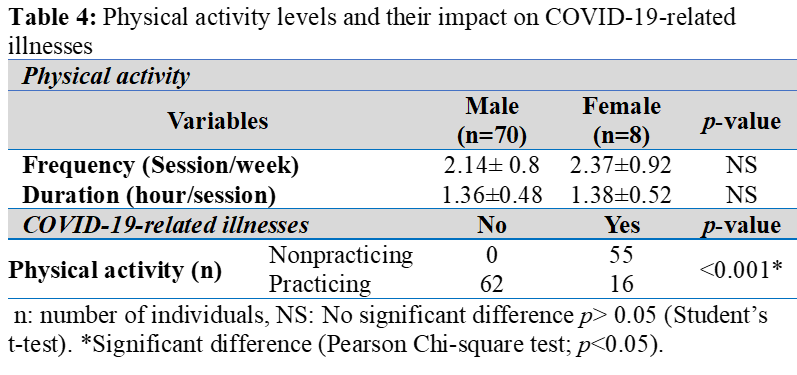
Background: Coronavirus (COVID-19) is a respiratory illness with global spread and significant health risks, particularly for individuals with comorbidities or weakened immunity. Objectives: This study evaluated the impact of COVID-19 on appetite, olfactory and gustatory functions, associated diseases, and the role of physical activity in health maintenance. Methods: A cross-sectional retrospective survey was conducted among 323 Algerian adults previously infected with COVID-19 (43.74±17.48 years; 175 females, 148 males). The questionnaire collected data on demographics, anthropometrics, COVID-19 symptoms, comorbidities, and physical activity levels. Results: Overweight and obesity were prevalent in 40.25% and 14.55% of participants, respectively, with significantly higher rates in those over 40 years (p=0.022). Sensory disturbances during infection were common: 84.21% experienced loss of smell, 75.54% loss of taste, and 37.46% appetite loss. A total of 21.98% reported COVID-19-related illnesses, primarily respiratory and cardiac complications. Notably, there was a strong inverse association between physical activity and disease occurrence (p<0.001; r=0.783), indicating that higher levels of physical activity are linked to a lower incidence of COVID-19-related illnesses. Conclusions: COVID-19 significantly affects sensory functions and contributes to comorbid conditions, especially among overweight and obese individuals. Regular physical activity appears to be a protective factor associated with reduced risk of COVID-19-related illness.
Downloads
References
Heunis C, Chikobvu P, Muteba M, Kigozi-Male G, Engelbrecht M, Mushori P. Impact of COVID-19 on selected essential public health services – lessons learned from a retrospective record review in the Free State, South Africa. BMC Health Serv Res. 2023;23(1):1–11. doi: 10.1186/s12913-023-10166-7. DOI: https://doi.org/10.1186/s12913-023-10166-7
Shereen MA, Khan S, Kazmi A, Bashir N, Siddique R. COVID-19 infection: Origin, transmission, and characteristics of human coronaviruses. J Adv Res. 2020;24:91–98. doi: 10.1016/j.jare.2020.03.005. DOI: https://doi.org/10.1016/j.jare.2020.03.005
Fekadu G, Bekele F, Tolossa T, Fetensa G, Turi E, Getachew M, et al. Impact of COVID-19 pandemic on chronic diseases care follow-up and current perspectives in low resource settings: a narrative review. Int J Physiol Pathophysiol Pharmacol. 2021;13(3):86–93. PMID: 34336132.
Zatla I, Boublenza L. The COVID-19 outbreak inception in Algeria : What Happened ? Alger J Heal Sci. 2023;5(1):35–38.
UNICEF. Country Office Annual Report 2021 Mexico - 2850 - UNICEF [Internet]. Country Office Annual Report 2021. 2021. Available from: https://www.unicef.org/media/115796/file/Algeria-2021-COAR.pdf
Sathian B, Asim M, Mekkodathil A, Van Teijlingen ER, Subramanya SH, Simkhada P, et al. Impact of COVID-19 on community health: A systematic review of a population of 82 million. J Adv Intern Med. 2020;9(1):4–11. doi: 10.3126/jaim.v9i1.29159. DOI: https://doi.org/10.3126/jaim.v9i1.29159
Lounis M. A brief review of clinical features of coronavirus disease 2019 (COVID-19) in Algeria. Eur J Environ Public Heal. 2021;5(2):em0078. doi: 10.21601/ejeph/10955. DOI: https://doi.org/10.21601/ejeph/10955
Silaghi-Dumitrescu R, Patrascu I, Lehene M, Bercea I. Comorbidities of COVID-19 patients. Medicina (Kaunas). 2023;59(8):1393. doi: 10.3390/medicina59081393. DOI: https://doi.org/10.3390/medicina59081393
Kruk J. Physical activity and health. Asian Pacific J Cancer Prev. 2009;10:721–728. PMID: 20104958.
World Health Organization. Seventy-First World Health Assembly A71/18 Provisional Agenda Item 12.2 Physical Activity For Health More Active People For A Healthier World: Draft Global Action Plan On Physical Activity 2018-2030 Report By The Director-General [Internet]. Vol. 2014. 2018. Available from: https://apps.who.int/gb/ebwha/pdf_files/WHA71/A71_18-en.pdf
WHO. Physical status: the use and interpretation of anthropometry. Report of a WHO Expert Committee. Geneva. Ser. WHOTR, editor. 1995.
CDC. Adult Physical Activity Questions on the National Health Interview Survey: 1975-2012 1975. Centers Dis Control Prev [Internet]. 2013; Available from: http://www.cdc.gov/nchs/nhis/physical_activity/pa_questions.htm
Taniguchi H, Okuda N, Arima H, Satoh A, Abe M, Nishi N, et al. Body weight and lifestyle changes under the COVID-19 pandemic in Japan: A cross-sectional study from NIPPON DATA2010. BMJ Open. 2022;12(11):1–11. doi: 10.1136/bmjopen-2022-063213. DOI: https://doi.org/10.1136/bmjopen-2022-063213
Schienkiewitz A, Damerow S, Richter A, Mensink GBM. How has body weight changed since the beginning of the COVID-19 pandemic? J Heal Monit. 2022;7(4):54–61. doi: 10.25646/10670.
Manolis AS, Manolis AA, Manolis TA, Apostolaki NE, Melita H. COVID-19 infection and body weight: A deleterious liaison in a J-curve relationship. Obes Res Clin Pract. 2021;15(6):523–535. doi: 10.1016/j.orcp.2021.10.006. DOI: https://doi.org/10.1016/j.orcp.2021.10.006
de la Rosa-Zamboni D, Ortega-Riosvelasco F, González-García N, Saldívar-Salazar S, Guerrero-Díaz AC. Correlation between body mass index and COVID-19 transmission risk. Int J Obes. 2022;46(12):2068–2069. doi: 10.1038/s41366-022-01215-y. DOI: https://doi.org/10.1038/s41366-022-01215-y
Sharetts R, Moein ST, Khan R, Doty RL. Long-term taste and smell outcomes after COVID-19. JAMA Netw Open. 2024;7(4):e247818. doi: 10.1001/jamanetworkopen.2024.7818. DOI: https://doi.org/10.1001/jamanetworkopen.2024.7818
Nguyen H, Albayay J, Höchenberger R, Bhutani S, Boesveldt S, Busch NA, et al. Covid-19 affects taste independent of taste-smell confusions: Results from a combined chemosensory home test and online survey from a large global cohort. Chem Senses. 2023;48:1–29. doi: 10.1093/chemse/bjad020. DOI: https://doi.org/10.1093/chemse/bjad020
Shigayeva Ferreira AM, do Nascimento JA, de Carvalho Palhano Travassos L, de Araújo Pernambuco L. Olfactory and taste disorders in COVID-19: a cross-sectional study in primary health care. Rev Assoc Med Bras. 2024;70(2):1–5. doi: 10.1590/1806-9282.20231018. DOI: https://doi.org/10.1590/1806-9282.20231018
Printza A, Katotomichelakis M, Valsamidis K, Metallidis S, Panagopoulos P, Panopoulou M, et al. Smell and taste loss recovery time in covid-19 patients and disease severity. J Clin Med. 2021;10(5):1–9. doi: 10.3390/jcm10050966. DOI: https://doi.org/10.3390/jcm10050966
Ali F, Hamid H, Khan LG, Ullah R, Waseem M, Ikram U, et al. Prevalence and duration of acute loss of smell or taste in COVID-19 patients. Int Med J. 2022;29(04):7691–769. doi: 10.1177/03000605221096280. DOI: https://doi.org/10.1177/03000605221096280
Hopkins C, Surda P, Kumar BN. Presentation of new onset anosmia during the COVID-19 pandemic. Rhinology. 2020;58(3):295–298. doi: 10.4193/Rhin20.116. DOI: https://doi.org/10.4193/Rhin20.116
Kaye R, Chang CWD, Kazahaya K, Brereton J, Denneny JC. COVID-19 Anosmia Reporting Tool: Initial Findings. Otolaryngol Head Neck Surg. 2020;163(1):132–134. doi: 10.1177/0194599820922992. DOI: https://doi.org/10.1177/0194599820922992
Santos REA, da Silva MG, do Monte Silva MCB, Barbosa DAM, Gomes AL do V, Galindo LCM, et al. Onset and duration of symptoms of loss of smell/taste in patients with COVID-19: A systematic review. Am J Otolaryngol. 2021;42(2):102889. doi: 10.1016/j.amjoto.2020.102889. DOI: https://doi.org/10.1016/j.amjoto.2020.102889
Hernández-Aceituno A, García-Hernández A, Larumbe-Zabala E. COVID-19 long-term sequelae: Omicron versus Alpha and Delta variants. Infect Dis Now. 2023;53(5):104688. doi: 10.1016/j.idnow.2023.104688. DOI: https://doi.org/10.1016/j.idnow.2023.104688
Okrzeja J, Sołomacha S, Alimowski M, Sowa P, Dubatówka M, Łapińska M, et al. Assessment of smell disturbances 6 months after COVID-19 in Polish population. Sci Rep. 2024;14(1):1–11. doi: 10.1038/s41598-024-62114-y. DOI: https://doi.org/10.1038/s41598-024-62114-y
WHO. The impact of COVID-19 on health and care workers: a closer look at deaths [Internet]. 2021. Available from: https://iris.who.int/bitstream/handle/10665/345300/WHO-HWF-WorkingPaper-2021.1-eng.pdf
del Rio C, Collins LF, Malani P. Long-term Health Consequences of COVID-19. JAMA. 2020;324(17):1723–1724. doi: 10.1001/jama.2020.19719. DOI: https://doi.org/10.1001/jama.2020.19719
Miyah Y, Benjelloun M, Lairini S, Lahrichi A. COVID-19 impact on public health, environment, human psychology, global socioeconomy, and education. Sci World J. 2022;2022:8. doi: 10.1155/2022/5578284. DOI: https://doi.org/10.1155/2022/5578284
Yang J, Li X, He T, Ju F, Qiu Y, Tian Z. Impact of physical activity on COVID-19. Int J Environ Res Public Health. 2022;19(14108):1–13. doi: 10.3390/ijerph192114108. DOI: https://doi.org/10.3390/ijerph192114108
Sallis R, Young DR, Tartof SY, Sallis JF, Sall J, Li Q, et al. Physical inactivity is associated with a higher risk for severe COVID-19 outcomes: A study in 48 440 adult patients. Br J Sports Med. 2021;55(19):1099–1105. doi: 10.1136/bjsports-2021-104080. DOI: https://doi.org/10.1136/bjsports-2021-104080
Castoldi RC, de Ângelo JC, Pereira TT, Dias RM, Negrão FJ. Relationship between physical exercise and COVID-19 (SARS-CoV-2): systematic review. Sport Sci Health. 2023;19(1):55–67. doi: 10.1007/s11332-022-01028-6. DOI: https://doi.org/10.1007/s11332-022-01028-6
Hill AL, Whitfield G, Morford M, Okasako-Schmucker DL, So CN, Wassef M, et al. Brief summary of findings on the association between physical inactivity and severe COVID-19 outcomes [Internet]. CDC. 2022. p. 1–63. Available from: https://www.cdc.gov/covid/media/pdfs/2025/02/Brief-Summary-of-Findings-on-the-Association-Between-Physical-Inactivity-and-Severe-COVID-19-Outcomes.pdf
WHO. Physical activity [Internet]. World Health Organization. 2024. Available from: https://www.who.int/news-room/fact-sheets/detail/physical-activity
Nieman DC, Sakaguchi CA. Physical activity lowers the risk for acute respiratory infections: Time for recognition. J Sport Heal Sci. 2022;11(6):648–655. doi: 10.1016/j.jshs.2022.08.002. DOI: https://doi.org/10.1016/j.jshs.2022.08.002
Downloads
Published
How to Cite
Issue
Section
License
Copyright (c) 2026 Al-Rafidain Journal of Medical Sciences ( ISSN 2789-3219 )

This work is licensed under a Creative Commons Attribution-NonCommercial-ShareAlike 4.0 International License.
Published by Al-Rafidain University College. This is an open access journal issued under the CC BY-NC-SA 4.0 license (https://creativecommons.org/licenses/by-nc-sa/4.0/).