Immune Imbalance Model of Classical Scabies in a Boarding School Setting: Evidence from Th17–Treg–Related Biomarkers and Clinical Severity
Keywords:
Foxp3, IL-17, IL-10, Immune imbalance, Lesion extent, Recurrence, Recurrence frequency, Th17–Treg axisAbstract
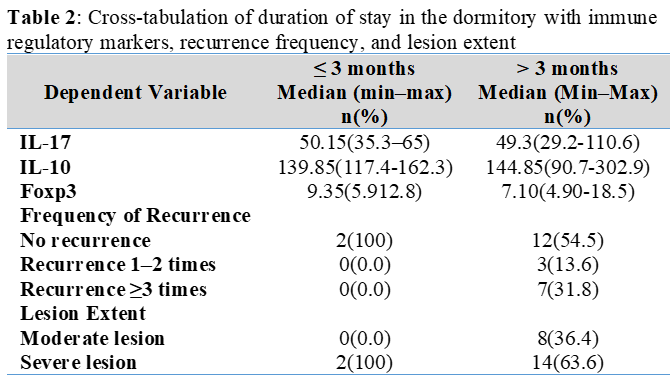
Background: Scabies remains a significant public health concern in communal living environments, where recurrence and variable lesion severity frequently occur. The imbalance between pro-inflammatory and regulatory immune responses, particularly within the Th17–Treg axis, may influence disease expression. Objective: This study aimed to evaluate the association between Th17–Treg–related biomarkers (IL-17, IL-10, and FoxP3) and clinical severity indicators in adolescents with classical scabies. Methods: An explanatory cross-sectional study was conducted among 24 adolescents diagnosed with classical scabies based on International Alliance for the Control of Scabies criteria. Serum IL-17, IL-10, and FoxP3 levels were measured using ELISA. Clinical severity was assessed based on lesion extent and recurrence frequency. Correlation analyses were performed to determine associations between immune biomarkers and clinical outcomes. Results: IL-17 levels were significantly inversely correlated with recurrence (r= –0.483, p=0.017) and lesion extent (r= –0.460, p=0.024). Conversely, IL-10 and FoxP3 levels were positively associated with recurrence and lesion severity, with FoxP3 demonstrating the strongest correlation with lesion extent (r=0.690, p<0.001). No significant associations were observed between demographic variables and clinical or immunological parameters. Conclusions: The findings suggest that reduced Th17 activity and enhanced regulatory immune responses contribute to recurrence and increased lesion severity in scabies within high-transmission settings.
Downloads
References
1. Chandler DJ, Fuller LC. A Review of scabies: An infestation more than skin deep. Dermatology. 2019;235:79–90. doi: 10.1159/000495290.
2. El-Moamly AA. Scabies as a part of the World Health Organization roadmap for neglected tropical diseases 2021–2030: what we know and what we need to do for global control. Trop Med Health. 2021;49:64. doi: 10.1186/s41182-021-00348-6.
3. Karimkhani C, Colombara D V, Drucker AM, Norton SA, Hay R, Engelman D, et al. The global burden of scabies: a cross-sectional analysis from the Global Burden of Disease Study 2015. Lancet Infect Dis. 2017;17:1247–1254. doi: 10.1016/S1473-3099(17)30483-8.
4. Abd El-Aal AA, Hassan MA, Gawdat HI, Ali MA, Barakat M. Immunomodulatory impression of anti and pro-inflammatory cytokines in relation to humoral immunity in human scabies. Int J Immunopathol Pharmacol. 2016;29:188–194. doi: 10.1177/0394632015627464.
5. Bhat SA, Mounsey KE, Liu X, Walton SF. Host immune responses to the itch mite, Sarcoptes scabiei, in humans. Parasit Vectors. 2017;10:385. doi: 10.1186/s13071-017-2320-4.
6. Li J, Liu Z, Xia X. The disability-adjusted life years (DALYs), prevalence and incidence of scabies, 1990-2021: A systematic analysis from the Global Burden of Disease Study 2021. PLoS Negl Trop Dis. 2024;18:e0012775. doi: 10.1371/journal.pntd.0012775.
7. Schneider S, Wu J, Tizek L, Ziehfreund S, Zink A. Prevalence of scabies worldwide-An updated systematic literature review in 2022. J Eur Acad Dermatol Venereol. 2023;37:1749–1757. doi: 10.1111/jdv.19167.
8. Widuri NA, Candrawati E, Masluhiya SA. Analysis of risk factors scabies on students in Pondok pesantren nurul hikmah desa kebonagung pakisaji malang. Nurs News. 2017;2(3). doi: doi: 10.33366/nn.v2i3.697.
9. Jackson A, Heukelbach J, Filho AF da S, Júnior E de BC, Feldmeier H. Clinical features and associated morbidity of scabies in a rural community in Alagoas, Brazil. Trop Med Int Health. 2007;12:493–502. doi: 10.1111/j.1365-3156.2006.01809.x.
10. Engelman D, Kiang K, Chosidow O, McCarthy J, Fuller C, Lammie P, Hay R, Steer A. Toward the Global Control of Human Scabies: Introducing the International Alliance for the Control of Scabies. PLoS Negl Trop Dis. 2013;7:e2167. doi: 10.1371/journal.pntd.0002167.
11. Dharmarajan TS, Kanwal S, Qureshi S. Scabies. In: Norman R, Dharmarajan TS, (eds), Geriatric Dermatology. Springer, Cham. 2025. doi: 10.1007/978-3-031-53888-9_32-1.
12. Mika A, Reynolds SL, Mohlin FC, Willis C, Swe PM, Pickering DA, et al. Novel scabies mite serpins inhibit the three pathways of the human complement system. PLoS One. 2012;7:e40489. doi: 10.1371/journal.pone.0040489.
13. Sharaf MS. Scabies: Immunopathogenesis and pathological changes. Parasitol Res. 2024;123:149. doi: 10.1007/s00436-024-08173-6.
14. Saito T, Nishikawa H, Wada H, Nagano Y, Sugiyama D, Atarashi K, et al. Two FOXP3(+)CD4(+) T cell subpopulations distinctly control the prognosis of colorectal cancers. Nat Med. 2016;22:679–684. doi: 10.1038/nm.4086.
15. Matar AM, Shehata WA, Kora MA, Shendi SS. Tissue and circulating levels of IL-17A and FoxP3+ in patients with scabies: Correlation with clinical features. Mol Biochem Parasitol. 2024;260:111652. doi: 10.1016/j.molbiopara.2024.111652.
16. Sakaguchi S, Mikami N, Wing JB, Tanaka A, Ichiyama K, Ohkura N. Regulatory T cells and human disease. Annu Rev Immunol. 2020;38:541–566. doi: 10.1146/annurev-immunol-042718-041717. Cited in PMID: 32017635.
17. Togashi Y, Shitara K, Nishikawa H. Regulatory T cells in cancer immunosuppression — implications for anticancer therapy. Nat Rev Clin Oncol. 2019;16:356–371. doi: 10.1038/s41571-019-0175-7.
18. Miossec P, Kolls JK. Targeting IL-17 and TH17 cells in chronic inflammation. Nat Rev Drug Discov. 2012;11:763–776. doi: 10.1038/nrd3794.
19. Yazici MU, Orhan D, Kale G, Besbas N, Ozen S. Studying IFN-gamma, IL-17 and FOXP3 in pediatric lupus nephritis. Pediatr Nephrol. 2014;29:853–862. doi: 10.1007/s00467-013-2695-1.
20. Yan KX, Fang X, Han L, Zhang Z-H, Kang KF, Zheng ZZ, et al. Foxp3+ regulatory T cells and related cytokines differentially expressed in plaque vs. guttate psoriasis vulgaris. Br J Dermatol. 2010;163:48–56. doi: 10.1111/j.1365-2133.2010.09742.x.
21. Dutzan N, Gamonal J, Silva A, Sanz M, Vernal R. Over‐expression of forkhead box P3 and its association with receptor activator of nuclear factor‐ κ B ligand, interleukin (IL) ‐17, IL‐10 and transforming growth factor‐ β during the progression of chronic periodontitis. J Clin Periodontol. 2009;36:396–403. doi: 10.1111/j.1600-051X.2009.01390.x.
22. Mohamed A, Ismail H, Zahran F, Zein N, Lindmark G, Hammarström ML, et al. High IL-10 mRNA levels in regional lymph nodes of colon cancer patients indicate poor prognosis. Front Immunol. 2025;16. doi: 10.3389/fimmu.2025.1589533.
23. Acikgoz B, Ozbagcivan O, Aktan S, Akhisaroglu ST, Said HM. Peripheral whole blood FOXP3 TSDR methylation and plasma IL-10, IL-17, IL-35, and IL-36 levels in psoriasis. Acta Dermatovenerol Croat. 2024;32:139–147. PMID: 40654212.
24. Aljabali MA, Kuts L. Serum levels of IL-2 and IL-17A are related to clinical type and severity of alopecia areata. Wiad Lek. 2022;75(1 pt 2):263-267. PMID: 35182133.
25. Araujo-Pires AC, Francisconi CF, Biguetti CC, Cavalla F, Aranha AMF, Letra A, et al. Simultaneous analysis of T helper subsets (Th1, Th2, Th9, Th17, Th22, Tfh, Tr1 and Tregs) markers expression in periapical lesions reveals multiple cytokine clusters accountable for lesions activity and inactivity status. J Appl Oral Sci. 2014;22:336–346. doi: 10.1590/1678-775720140140.
26. Díaz-Palomera CD, Rosales-Díaz R, Martínez-Rizo AB, Alvarado-Castillo B, Santos A, Navarro-Partida J. Evaluation of the expression of T helper lymphocytes markers associated with Th1, Th2, Th17, and Treg cells in primary pterygium biopsies. Revista Mexicana de Oftalmología. 2019;92. doi: 10.24875/RMO.M18000011.
27. Mounsey KE, Holt DC, McCarthy J, Currie BJ, Walton SF. Scabies: molecular perspectives and therapeutic implications in the face of emerging drug resistance. Future Microbiol. 2008;3:57–66. doi: 10.2217/17460913.3.1.57.
28. Walton SF, Currie BJ. Problems in diagnosing scabies, a global disease in human and animal populations. Clin Microbiol Rev. 2007;20:268–279. doi: 10.1128/CMR.00042-06.
29. Ouchi N, Parker JL, Lugus JJ, Walsh K. Adipokines in inflammation and metabolic disease. Nat Rev Immunol. 2011;11:85–97. doi: 10.1038/nri2921.
30. Zhu L, Song H, Zhang L, Meng H. Characterization of IL-17-producing Treg cells in type 2 diabetes patients. Immunol Res. 2019;67:443–449. doi: 10.1007/s12026-019-09095-7.
31. Schisterman EF, Cole SR, Platt RW. Overadjustment bias and unnecessary adjustment in epidemiologic studies. Epidemiology. 2009;20:488–495. doi: 10.1097/EDE.0b013e3181a819a1.
32. WHO. Scabies [Internet]. World Health Organization. 2023 [cited 2026 Feb 1]. Available from: https://www.who.int/news-room/fact-sheets/detail/scabies.
33. Sukmawati S, Ahmad H, Islam F, Akbar F. Risk factors for scabies incidence among students at Islamic Boarding Schools in Mamuju Regency, Indonesia. J Med Health. 2025;7:163–171. doi: 10.28932/jmh.v7i2.9245.
34. Hasan MJ, Rafi MA, Choudhury T, Hossain MG. Prevalence and risk factors of scabies among children living in Madrasahs (Islamic religious boarding schools) of Bangladesh: a cross-sectional study. BMJ Paediatr Open. 2024;8:e002421. doi: 10.1136/bmjpo-2023-002421.
Downloads
Published
How to Cite
Issue
Section
License
Copyright (c) 2026 Al-Rafidain Journal of Medical Sciences ( ISSN 2789-3219 )

This work is licensed under a Creative Commons Attribution-NonCommercial-ShareAlike 4.0 International License.
Published by Al-Rafidain University College. This is an open access journal issued under the CC BY-NC-SA 4.0 license (https://creativecommons.org/licenses/by-nc-sa/4.0/).