Neuroimmunological Shifts in Disease-Modifying Therapy Use Among Multiple Sclerosis Patients: A Regional Study from Sulaymaniyah, Iraq
DOI:
https://doi.org/10.54133/ajms.v11i2.3387Keywords:
Disease-modifying therapy, Corticosteroids, Geographical distribution, Multiple sclerosisAbstract
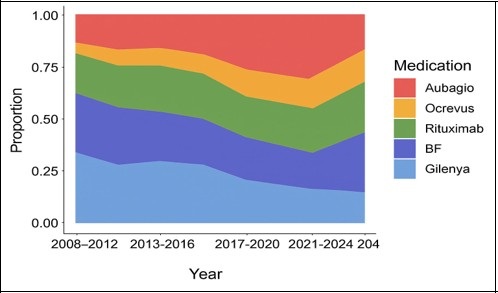
Background: Multiple sclerosis (MS) is a chronic demyelinating disease of the central nervous system with a growing global prevalence. In Iraq, diagnostic rates are increasing alongside changes in environmental exposures. Objective: To describe the regional epidemiological burden of MS and the patterns of disease-modifying therapy (DMT) prescriptions in Sulaymaniyah, stratified by gender, age, and temporal changes in therapeutic approaches to immune-targeted treatments. Methods: This retrospective, registry-based observational study utilized data from the Shar Hospital MS registry (2007-2025). A total of 697 confirmed MS cases were identified, of which 643 were eligible for therapeutic analysis. Extracted variables included age, sex, residential area, and prescribed DMTs. Temporal changes in DMT prescribing and associations between sex and DMT type were analyzed using chi-square tests, while age differences by sex were assessed using independent-samples t-tests. Results: The cohort was mainly female (72.6%), with a mean age of 42.86±13 years. No significant difference in mean age was seen between sexes (p=0.60). DMT prescribing patterns changed notably over time (p<0.001), with less use of broad immunomodulators such as fingolimod and interferon beta and more use of high-efficacy immune-targeted therapies, especially B-cell-depleting monoclonal antibodies. No statistically significant link was found between sex and DMT type (p=0.066). Conclusions: In this registry-based cohort, MS mainly affected females, and DMT prescribing shifted over time toward higher-efficacy immune-targeted therapies. Prospective studies incorporating clinical outcomes such as relapse activity, disability progression, and MRI measures are needed to assess the effectiveness and long-term impact of these evolving treatment strategies in this setting.
Downloads
References
1. Oliveira CC, Charalampous P, Delaye J, Grad DA, Kolkhir P, Mechili EA, et a. A systematic review of studies that estimated the burden of chronic non-communicable rare diseases using disability-adjusted life years. Orphanet J Rare Dis. 2024;19(1):333. doi: 10.1186/s13023-024-03342-3.
2. Wu X, Wang S, Xue T, Tan X, Li J, Chen Z, et al. Disease-modifying therapy in progressive multiple sclerosis: a systematic review and network meta-analysis of randomized controlled trials. Front Neurol. 2024;15:1295770. doi: 10.3389/fneur.2024.1295770.
3. Walton C, King R, Rechtman L, Kaye W, Leray E, Marrie RA, et al. Rising prevalence of multiple sclerosis worldwide: Insights from the Atlas of MS, third edition. Mult Scler. 2020;26(14):1816-1821. doi: 10.1177/1352458520970841.
4. D’Anca M, Buccellato FR, Tartaglia GM, Del Fabbro M, Muti P, Scarpini E, et al. Why is multiple sclerosis more frequent in women? Role of the immune system and of oral and gut microbiota. Applied Sciences. 2023;13(10):5881. doi: 10.3390/app13105881.
5. Barbuti E, Piervincenzi C, Ruggieri S, Petracca M. Sex-related differences in lifestyle factors affecting multiple sclerosis susceptibility and disease progression. Brain Sci. 2025;15(10):1097. doi: 10.3390/brainsci15101097.
6. Watson C, Thirumalai D, Barlev A, Jones E, Bogdanovich S, Kresa-Reahl K. Treatment patterns and unmet need for patients with progressive multiple sclerosis in the united states: Survey results from 2016 to 2021. Neurol Ther. 2023;12(6):1961-1979. doi: 10.1007/s40120-023-00532-2.
7. Hassoun HK, Al-Mahadawi A, Sheaheed NM, Sami SM, Jamal A, Allebban Z. Epidemiology of multiple sclerosis in Iraq: retrospective review of 4355 cases and literature review. Neurol Res. 2022;44(1):14-23. doi: 10.1080/01616412.2021.1952511.
8. Olejnik P, Roszkowska Z, Adamus S, Kasarełło K. Multiple sclerosis: a narrative overview of current pharmacotherapies and emerging treatment prospects. Pharmacol Rep. 2024;76(5):926-943. doi: 10.1007/s43440-024-00642-0.
9. Wingerchuk DM, Carter JL. Multiple sclerosis: current and emerging disease-modifying therapies and treatment strategies. Mayo Clin Proc. 2014;89(2):225-240. doi: 10.1016/j.mayocp.2013.11.002.
10. Filippi M, Amato MP, Centonze D, Gallo P, Gasperini C, Inglese M, et al. Early use of high-efficacy disease modifying therapies makes the difference in people with multiple sclerosis: an expert opinion. Erratum in: J Neurol. 2022;269(12):6690-6691. doi: 10.1007/s00415-022-11385-4.
11. Ysrraelit MC, Correale J. Impact of sex hormones on immune function and multiple sclerosis development. Immunology. 2019;156(1):9-22. doi: 10.1111/imm.13004.
12. Alroughani R, Ashkanani A, Lamdhade S. Clinical characteristics of multiple sclerosis in Kuwait: data from the new MS registry of Amiri Hospital. Int J Neurosci. 2012;122(2):82-87. doi: 10.3109/00207454.2011.630543.
13. Waubant E, Lucas R, Mowry E, Graves J, Olsson T, Alfredsson L, et al. Environmental and genetic risk factors for MS: an integrated review. Ann Clin Transl Neurol. 2019;6(9):1905-1922. doi: 10.1002/acn3.50862.
14. Bove R, Musallam A, Healy BC, Houtchens M, Glanz BI, Khoury S, et al. No sex-specific difference in disease trajectory in multiple sclerosis patients before and after age 50. BMC Neurol. 2013;13:73. doi: 10.1186/1471-2377-13-73.
15. Cheong WL, Mohan D, Warren N, Reidpath DD. Multiple sclerosis in the Asia Pacific region: A systematic review of a neglected neurological disease. Front Neurol. 2018;9:432. doi: 10.3389/fneur.2018.00432.
16. Cree BAC, Berger JR, Greenberg B. The evolution of anti-CD20 treatment for multiple sclerosis: Optimization of antibody characteristics and function. Erratum in: CNS Drugs. 2025;39(7):721-724. doi: 10.1007/s40263-025-01187-3.
17. Simpson A, Mowry EM, Newsome SD. Early aggressive treatment approaches for multiple sclerosis. Curr Treat Options Neurol. 2021;23(7):19. doi: 10.1007/s11940-021-00677-1
18. Narang GL, Pannell SC, Laviana AA, Huen KHY, Izard J, Smith AB, et al. Patient-reported outcome measures in urology. Curr Opin Urol. 2017;27(4):366-374. doi: 10.1097/MOU.0000000000000412.
19. Kalincik T, Vivek V, Jokubaitis V, Lechner-Scott J, Trojano M, Izquierdo G, et al. Sex as a determinant of relapse incidence and progressive course of multiple sclerosis. Brain. 2013;136(Pt 12):3609-3617. doi: 10.1093/brain/awt281.
20. Alroughani R, Inshasi J, Al-Asmi A, Alqallaf A, Al Salti A, Shatila A, et al. Expert consensus from the Arabian Gulf on selecting disease-modifying treatment for people with multiple sclerosis according to disease activity. Postgrad Med. 2020;132(4):368-376. doi: 10.1080/00325481.2020.1734394.
Downloads
Published
How to Cite
Issue
Section
License
Copyright (c) 2026 Al-Rafidain Journal of Medical Sciences ( ISSN 2789-3219 )

This work is licensed under a Creative Commons Attribution-NonCommercial-ShareAlike 4.0 International License.
Published by Al-Rafidain University College. This is an open access journal issued under the CC BY-NC-SA 4.0 license (https://creativecommons.org/licenses/by-nc-sa/4.0/).