Enhancing the Anticancer Efficacy of Decitabine via β-Hydroxybutyrate in Colorectal and Prostate Cancers Cell Lines
DOI:
https://doi.org/10.54133/ajms.v11i2.3363Keywords:
β-hydroxybutyrate, Colorectal cancer, Decitabine, DNMT1, Prostate cancerAbstract
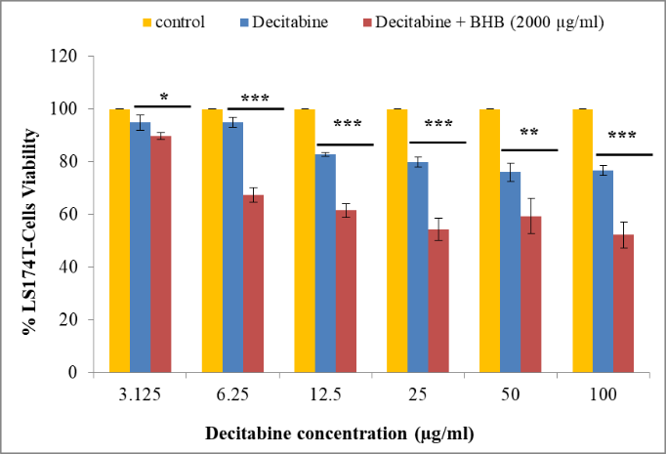
Background: Epigenetic targeting therapy, including histone deacetylase (HDAC) inhibitors and DNA-methyltransferase 1 (DNMT1) inhibitors, is a promising and attractive tool to treat advanced cancers, overcome drug resistance, and minimize adverse effects of traditional therapies. Objective: To investigate whether β-hydroxybutyrate enhanced the effectiveness of decitabine against colon cancer and enhanced the anti-cancer effect of decitabine against colon and prostate cancer cell lines. Methods: LS174T cells (colorectal cancer) and PC3 cells (prostate cancer) were seeded in a 96-well cell culture plate. Decitabine was used in six [100, 50, 25, 12.5, 6.25, & 3.125μg/ml] concentrations alone and combined with β-hydroxybutyrate, enhancing the effectiveness of decitabine against colon (2000μg/ml). After 48 hours of incubation, LS174T cells and PC3 cell viability were determined by MTT assay. DNMT1-enzyme level was measured using the DNMT1-ELISA kit. Results: For the LS174T cell line and PC3 cell line, the combination of decitabine plus β-hydroxybutyrate enhanced the effectiveness of decitabine against colon and showed a significant (p<0.05) decrease in viability percent for all concentrations compared to the control group. Also, the comparison between decitabine monotherapy and decitabine plus β-hydroxybutyrate enhanced the effectiveness of decitabine against colon and revealed a significant (p<0.05) difference in viability between the two groups. Finally, a significant (p<0.05) reduction in DNMT1 level was observed between monotherapy and combination therapy for all decitabine concentrations and for both cell lines. Conclusions: β-hydroxybutyrate enhanced the effectiveness of decitabine against colon and prostate cancers, suggesting that β-hydroxybutyrate may serve as a promising adjuvant to decrease decitabine therapeutic doses.
Downloads
References
1. World Health Organization (WHO) and the International Agency for Research on Cancer (IARC), Globocan 2024. Available at: https://gco.iarc.who.int
2. Karnwal A, Dutta J, Al-Tawaha AR, Nesterova N. Genetic landscape of cancer: mechanisms, key genes, and therapeutic implications. Clin Transl Oncol. 2026;28(2):424-445. doi: 10.1007/s12094-025-04019-4.
3. Elhamamsy AR. DNA methylation dynamics in plants and mammals: overview of regulation and dysregulation. Cell Biochem Funct. 2016;34(5):289–298. doi: 10.1002/cbf.3183.
4. Parry A, Rulands S, Reik W. Active turnover of DNA methylation during cell fate decisions. Nat Rev Genet. 2021;22(1):59-66. doi: 10.1038/s41576-020-00287-8.
5. Liu J, Zhang X, Huang Y, Zhang Q, Zhou J, Zhang X, et al. mir-200b and mir-200c co-contribute to the cisplatin sensitivity of ovarian cancer cells by targeting DNA methyltransferases. Oncol Lett. 2019;17(2):1453–1460. doi: 10.3892/ol.2018.9745.
6. Kim DJ. The role of the DNA methyltransferase family and the therapeutic potential of DNMT inhibitors in tumor treatment. Curr Oncol. 2025;32(2):88. doi: 10.3390/curroncol32020088.
7. Liu P, Yang F, Zhang L, Hu Y, Chen B, Wang J, et al. Emerging role of different DNA methyltransferases in the pathogenesis of cancer. Front Pharmacol. 2022;13:958146. doi: 10.3389/fphar.2022.958146.
8. Hu C, Liu X, Zeng Y, Liu J, Wu F. DNA methyltransferase inhibitors combination therapy for the treatment of solid tumor: mechanism and clinical application. Clin Epigenet. 2021;13(1):166. doi: 10.1186/s13148-021-01154-x.
9. Chen R, Zhang M, Zhou Y, Guo W, Yi M, Zhang Z, et al. The application of histone deacetylases inhibitors in glioblastoma. J Exp Clin Cancer Res. 2020;39(1):1–18. doi: 10.1186/s13046-020-01643-6.
10. Nitsch S, Zorro Shahidian L, Schneider R. Histone acylations and chromatin dynamics: concepts, challenges, and links to metabolism. EMBO Rep. 2021;22(7):EMBR202152774. doi: 10.15252/embr.202152774.
11. Imran K, Iqbal MJ, Ahmed MM, Khalid A, Cortés H, Reyes-Hernández OD, et al. Epigenetic dysregulation in cancer: mechanisms, diagnostic biomarkers and therapeutic strategies. Med Oncol. 2025;42(8):359. doi: 10.1007/s12032-025-02905-z.
12. Feng S, Wang H, Liu J, Aa J, Zhou F, Wang G. Multi-dimensional roles of ketone bodies in cancer biology: Opportunities for cancer therapy. Pharmacol Res. 2019;150:104500. doi: 10.1016/j.phrs.2019.104500.
13. Mierziak J, Burgberger M, Wojtasik W. 3-Hydroxybutyrate as a metabolite and a signal molecule regulating processes of living organisms. Biomolecules. 2021;11(3):402. doi: 10.3390/biom11030402.
14. Kagan AB, Garrison DA, Anders NM, Webster JA, Baker SD, Yegnasubramanian S, et al. DNA methyltransferase inhibitor exposure–response: Challenges and opportunities. Clin Transl Sci. 2023;16(8):1309-22. doi: 10.1111/cts.13548.
15. Gu M, Ren B, Fang Y, Ren J, Liu X, Wang X, et al. Epigenetic regulation in cancer. MedComm. 2024;5(2):e495. doi: 10.1002/mco2.495.
16. Hu D, Zhao T, Xu C, Pan X, Zhou Z, Wang S. Epigenetic modifiers in cancer metastasis. Biomolecules. 2024;14(8):916. doi: 10.3390/biom14080916.
17. Suraweera A, O’Byrne KJ, Richard DJ. Epigenetic drugs in cancer therapy. Cancer Metastasis Rev. 2025;44(1):37. doi: 10.1007/s10555-025-10253-7.
18. El Omari N, Bakrim S, Bakha M, Balahbib A, Bouyahya A, Ardianto C, et al. DNA methylation: its role and interaction with epigenetic modifications in cancer. Prog Microbe Mol Biol. 2025;8(1). doi: 10.36877/pmmb.a0000458.
19. Vafadar A, Mokaram P, Erfani M, Yousefi Z, Farhadi A, Elham Shirazi T, et al. The effect of decitabine on the expression and methylation of the PPP1CA, BTG2, and PTEN in association with changes in miR‐125b, miR‐17, and miR‐181b in NALM6 cell line. J Cell Biochem. 2019;120(8):13156-13167. doi: 10.1002/jcb.28590.
20. Mikami D, Kobayashi M, Uwada J, Yazawa T, Kamiyama K, Nishimori K, et al. β-Hydroxybutyrate enhances the cytotoxic effect of cisplatin via the inhibition of HDAC/survivin axis in human hepatocellular carcinoma cells. J Pharmacol Sci. 2020;142(1):1-8. doi: 10.1016/j.jphs.2019.10.007.
21. Wang C, Hamacher A, Petzsch P, Köhrer K, Niegisch G, Hoffmann MJ, et al. Combination of decitabine and entinostat synergistically inhibits urothelial bladder cancer cells via activation of FoxO1. Cancers. 2020;12(2):337. doi: 10.3390/cancers12020337.
22. Najem SA, Khawaja G, Hodroj MH, Rizk S. Synergistic effect of epigenetic inhibitors Decitabine and Suberoylanilide Hydroxamic acid on colorectal Cancer in vitro. Curr Mol Pharmacol. 2019;12(4):281-300. doi: 10.2174/1874467212666190313154531.
23. Zhou Q, Agoston AT, Atadja P, Nelson WG, Davidson NE. Inhibition of histone deacetylases promotes ubiquitin-dependent proteasomal degradation of DNA methyltransferase 1 in human breast cancer cells. Mol Cancer Res. 2008;6(5):873-883. doi: 10.1158/1541-7786.MCR-07-0330.
24. Young CS, Clarke KM, Kettyle LM, Thompson A, Mills KI. Decitabine-Vorinostat combination treatment in acute myeloid leukemia activates pathways with potential for novel triple therapy. Oncotarget. 2017;8(31):51429. doi: 10.18632/oncotarget.18009.
25. Zhang X, Bustos MA, Shoji Y, Ramos RI, Iida Y, Gentry R, et al. Acetylated DNMT1 downregulation and related regulatory factors influence metastatic melanoma patients survival. Cancers. 2021;13(18):4691. doi: 10.3390/cancers13184691.
Downloads
Published
How to Cite
Issue
Section
License
Copyright (c) 2026 Al-Rafidain Journal of Medical Sciences ( ISSN 2789-3219 )

This work is licensed under a Creative Commons Attribution-NonCommercial-ShareAlike 4.0 International License.
Published by Al-Rafidain University College. This is an open access journal issued under the CC BY-NC-SA 4.0 license (https://creativecommons.org/licenses/by-nc-sa/4.0/).