Azilsartan Attenuates Cognitive Dysfunction in a Rat Model of Cisplatin-Induced Neurotoxicity: Effects on Hematological and CBC-Derived Inflammatory Indices
DOI:
https://doi.org/10.54133/ajms.v11i2.3353Keywords:
Azilsartan, Cognitive function, Cisplatin, Hematological parameter, Inflammatory marker, NeurotoxicityAbstract
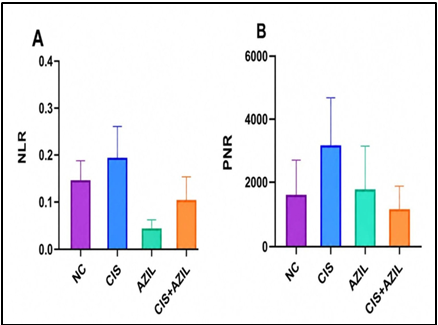
Background: Cisplatin (CIS) is one of the common anticancer agents; nevertheless, its utility is often associated with cognitive dysfunction as well as systemic toxicities. Current therapeutic options remain inadequate in its prevention or management. Objective: To investigate the effect of AZIL to mitigate CIS-induced neurotoxicity and associated systemic alterations in rats. Methods: Thirty-nine female rats were initially enrolled and divided into 4 groups: I: Normal control group (NC), II: Cisplatin group (CIS), III: azilsartan group (AZIL), and IV: CIS and AZIL combination group (CIS+AZIL). Neurotoxicity was induced using 2.5mg/kg CIS twice weekly for 4 weeks. Body weight was measured weekly. Cognitive performance was assessed via the Y-maze test at baseline and the end of the experiment. Blood was collected at the end of the study for hematology and inflammatory index assessments. Results: Azilsartan mitigated CIS-induced neurotoxicity and enhanced cognitive function. By week 4 CIS markedly lowers body weight, which is not prevented by AZIL. In the combination group, AZIL significantly improved learning performance and spatial working memory (p=0.0009) at week 4 compared to the CIS group. Hematological alterations were minimal, while co-administration of AZIL showed non-significant effects in NLR and PNR (p>0.05). Conclusions: Azilsartan mitigated CIS-induced neurotoxicity and improved cognitive performance and several hematological parameters, especially RBC and hemoglobin. Changes in CBC-derived inflammatory indices showed limited alterations.
Downloads
References
1. Zhang J, Wang L, Xing Z, Liu D, Sun J, Li X, et al. Status of Bi- and Multi-nuclear platinum anticancer drug development. Anticancer Agents Med Chem. 2010;10(4):272–282. doi: 10.2174/187152010791162270.
2. Ahmad S. Platinum–DNA interactions and subsequent cellular processes controlling sensitivity to anticancer platinum complexes. Chem Biodiver. 2010;7(3):543–566. doi: 10.1002/cbdv.200800340.
3. Von Hoff DD, Rozencweig M. cis-Diamminedichloroplatinum (II): A metal complex with significant anticancer activity. Adv Pharmacol Chemother. 1979;16:273–298. doi: 10.1016/S1054-3589(08)60247-1.
4. Avan A, Postma TJ, Ceresa C, Avan A, Cavaletti G, Giovannetti E, et al. Platinum-induced neurotoxicity and preventive strategies: Past, present, and future. Oncologist. 2015;20(4):411–432. doi: 10.1634/theoncologist.2014-0044.
5. Santos NAGD, Ferreira RS, Santos ACD. Overview of cisplatin-induced neurotoxicity and ototoxicity, and the protective agents. Food Chem Toxicol. 2020;136:111079. doi: 10.1016/j.fct.2019.111079.
6. Andres AL, Gong X, Di K, Bota DA. Low-doses of cisplatin injure hippocampal synapses: A mechanism for ‘chemo’ brain? Exp Neurol. 2014;255:137–144. doi: 10.1016/j.expneurol.2014.02.020.
7. Alotayk LI, Aldubayan MA, Alenezi SK, Anwar MJ, Alhowail AH. Comparative evaluation of doxorubicin, cyclophosphamide, 5-fluorouracil, and cisplatin on cognitive dysfunction in rats: Delineating the role of inflammation of hippocampal neurons and hypothyroidism. Biomed Pharmacother. 2023;165:115245. doi: 10.1016/j.biopha.2023.115245.
8. Alhowail AH. Cisplatin induces hippocampal neurotoxicity and cognitive impairment in rats through neuroinflammation, oxidative stress, and overexpression of glutamatergic receptors mRNA. Front Pharmacol. 2025;16:1592511. doi: 10.3389/fphar.2025.1592511.
9. John T, Lomeli N, Bota DA. Systemic cisplatin exposure during infancy and adolescence causes impaired cognitive function in adulthood. Behav Brain Res. 2017;319:200-206. doi: 10.1016/j.bbr.2016.11.013.
10. Qi L, Luo Q, Zhang Y, Jia F, Zhao Y, Wang F. Advances in toxicological research of the anticancer drug cisplatin. Chem Res Toxicol. 2019;32(8):1469-1486. doi: 10.1021/acs.chemrestox.9b00204.
11. Elmorsy EA, Saber S, Hamad RS, Abdel-Reheim MA, El-kott AF, AlShehri MA, et al. Advances in understanding cisplatin-induced toxicity: Molecular mechanisms and protective strategies. Eur J of Pharm Sci. 2024;203:106939. doi: 10.1016/j.ejps.2024.106939.
12. Zahorec R. Neutrophil-to-lymphocyte ratio, past, present and future perspectives. Bratisl Lek Listy. 2021;122(07):474-488. doi: 10.4149/BLL_2021_078.
13. Islam MM, Satici MO, Eroglu SE. Unraveling the clinical significance and prognostic value of the neutrophil-to-lymphocyte ratio, platelet-to-lymphocyte ratio, systemic immune-inflammation index, systemic inflammation response index, and delta neutrophil index: An extensive literature review. Turk J of Emerg Med. 2024;24(1):8-19. doi: 10.4103/tjem.tjem_198_23.
14. Jackson L, Eldahshan W, Fagan S, Ergul A. Within the brain: The renin angiotensin system. Int J Mol Sci. 2018;19(3):876. doi: 10.3390/ijms19030876.
15. Cantero-Navarro E, Fernández-Fernández B, Ramos AM, Rayego-Mateos S, Rodrigues-Diez RR, Sánchez-Niño MD, et al. Renin-angiotensin system and inflammation update. Mol Cell Endocrinol. 2021;529:111254. doi: 10.1016/j.mce.2021.111254.
16. Zaiken K, Cheng JWM. Azilsartan medoxomil: A new angiotensin receptor blocker. Clin Ther. 2011;33(11):1577-1589. doi: 10.1016/j.clinthera.2011.10.007.
17. Iwanami J, Mogi M, Tsukuda K, Wang XL, Nakaoka H, Ohshima K, et al. Role of angiotensin-converting enzyme 2/angiotensin-(1–7)/Mas axis in the hypotensive effect of azilsartan. Hypertens Res. 2014;37(7):616-620. doi: 10.1038/hr.2014.49.
18. Garg S, Khan SI, Malhotra RK, Sharma MK, Kumar M, Kaur P, et al. Cardioprotective effects of azilsartan compared with that of telmisartan on an in vivo model of myocardial ischemia‐reperfusion injury. J Biochem Mol Tox. 2021;35(7):e22785. doi: 10.1002/jbt.22785.
19. Percie Du Sert N, Hurst V, Ahluwalia A, Alam S, Avey MT, Baker M, et al. The ARRIVE guidelines 2.0: Updated guidelines for reporting animal research. PLoS Biol. 2020;18(7):e3000410. doi: 10.1371/journal.pbio.3000410.
20. Saadati H, Noroozzadeh S, Esmaeili H, Amirshahrokhi K, Shadman J, Niapour A. The neuroprotective effect of Mesna on cisplatin-induced neurotoxicity: Behavioral, electrophysiological, and molecular studies. Neurotox Res. 2021;39(3):826-840. doi: 10.1007/s12640-020-00315-9.
21. Cavaletti G, Petruccioli MG, Tredici G, Marmiroli P, Barajon I, Fabbrica D, et al. Effects of repeated administration of low doses of cisplatin on the rat nervous system. Int J Tissue React. 1991;13(3):151-157. PMID: 1960015.
22. Raheem NM, Mohammed Ali Mahmood N. Azilsartan suppresses the antiapoptotic biomarker and pro-inflammatory cytokines in rat model of cisplatin-induced retinal and optic nerve toxicity. Hum Exp Toxicol. 2023;42:09603271231155092. doi: 10.1177/09603271231155092.
23. Alzahrani YM, Alim A. Sattar MA, Kamel FO, Ramadan WS, Alzahrani YA. Possible combined effect of perindopril and Azilsartan in an experimental model of dementia in rats. Saudi Pharm J. 2020;28(5):574-581. doi: 10.1016/j.jsps.2020.03.009.
24. Kraeuter AK, Guest PC, Sarnyai Z. The Y-Maze for assessment of spatial working and reference memory in mice. Methods Mol Biol. 2019;1916:105-111. doi :10.1007/978-1-4939-8994-2_10.
25. Zahorec R. Ratio of neutrophil to lymphocyte counts--rapid and simple parameter of systemic inflammation and stress in critically ill. Bratisl Lek Listy. 2001;102(1):5-14.
26. Wang H, Qing X, Wang H, Gu Y. Association between platelet to neutrophil ratio (PNR) and clinical outcomes in STEMI patients after successful pPCI: A secondary analysis based on a cohort study. Cardiovascular Ther. 2022;2022:1-8. doi: 10.1155/2022/2022657.
27. Wright JW, Harding JW. The brain renin–angiotensin system: a diversity of functions and implications for CNS diseases. Pflugers Arch. 2013;465(1):133-151. doi: 10.1007/s00424-012-1102-2.
28. Lin MT, Ko JL, Liu TC, Chao PT, Ou CC. Protective effect of D-methionine on body weight loss, anorexia, and nephrotoxicity in cisplatin-induced chronic toxicity in rats. Integr Cancer Ther. 2018;17(3):813-824. doi: 10.1177/1534735417753543.
29. Mahmood NMA. Protective effects of Azilsartan against cyclophosphamide-induced ovarian toxicity in rats model. Toxicol Res. 2024;13(2):tfae027. doi: 10.1093/toxres/tfae027.
30. Ojima M, Igata H, Tanaka M, Sakamoto H, Kuroita T, Kohara Y, et al. In vitro antagonistic properties of a new angiotensin type 1 receptor blocker, azilsartan, in receptor binding and function studies. J Pharmacol and Exp Ther. 2011;336(3):801-808. doi: 10.1124/jpet.110.176636.
31. Altunkaya M, Ateş MB, Bulut A, Abuşoğlu G, Öztürk B. Cisplatin-induced toxicity in the hippocampus: a dose-dependent mechanism of damage. BMC Pharmacol Toxicol. 2025;26(1):215. doi: 10.1186/s40360-025-01050-7.
32. Abd Rashid N, Abd Halim SAS, Teoh SL, Budin SB, Hussan F, Adib Ridzuan NR, et al. The role of natural antioxidants in cisplatin-induced hepatotoxicity. Biomed Pharmacother. 2021;144:112328. doi: 10.1016/j.biopha.2021.112328.
33. Patel S, Sathyanathan V, Salaman SD. Molecular mechanisms underlying cisplatin-induced nephrotoxicity and the potential ameliorative effects of essential oils: A comprehensive review. Tissue Cell. 2024;88:102377. doi: 10.1016/j.tice.2024.102377.
34. Lastra G, Santos FR, Hooshmand P, Hooshmand P, Mugerfeld I, Aroor AR, et al. The novel angiotensin II receptor blocker azilsartan medoxomil ameliorates insulin resistance induced by chronic angiotensin II treatment in rat skeletal muscle. Cardiorenal Med. 2013;3(2):154-164. doi: 10.1159/000353155.
35. Malik NM, Moore GBT, Smith G, Liu YL, Sanger GJ, Andrews PLR. Behavioural and hypothalamic molecular effects of the anti-cancer agent cisplatin in the rat: A model of chemotherapy-related malaise? Pharmacol Biochem Behav. 2006;83(1):9-20. doi: 10.1016/j.pbb.2005.11.017.
36. Malik NM, Liu YL, Cole N, Sanger GJ, Andrews PLR. Differential effects of dexamethasone, ondansetron and a tachykinin NK1 receptor antagonist (GR205171) on cisplatin-induced changes in behaviour, food intake, pica and gastric function in rats. Eur J Pharmacol. 2007;555(2–3):164-173. doi: 10.1016/j.ejphar.2006.10.043.
37. Zhou Z, Orchard SG, Nelson MR, Fravel MA, Ernst ME. Angiotensin receptor blockers and cognition: a Scoping review. Curr Hypertens Rep. 2024;26(1):1-19. doi: 10.1007/s11906-023-01266-0.
38. Ho JK, Nation DA. Cognitive benefits of angiotensin IV and angiotensin-(1–7): A systematic review of experimental studies. Neurosci Biobehav Rev. 2018;92:209-225. doi: 10.1016/j.neubiorev.2018.05.005.
39. Rukavina Mikusic NL, Pineda AM, Gironacci MM. Angiotensin-(1-7) and Mas receptor in the brain. Explor Med. 2021;2(3):268-293. doi: 10.37349/emed.2021.00046.
40. Hamouda HA, Sayed RH, Eid NI, El-Sayeh BM. Azilsartan attenuates 3-nitropropinoic acid-induced neurotoxicity in rats: The role of IĸB/NF-ĸB and KEAP1/Nrf2 signaling pathways. Neurochem Res. 2024;49(4):1017-1033. doi: 10.1007/s11064-023-04083-8.
Downloads
Published
How to Cite
Issue
Section
License
Copyright (c) 2026 Al-Rafidain Journal of Medical Sciences ( ISSN 2789-3219 )

This work is licensed under a Creative Commons Attribution-NonCommercial-ShareAlike 4.0 International License.
Published by Al-Rafidain University College. This is an open access journal issued under the CC BY-NC-SA 4.0 license (https://creativecommons.org/licenses/by-nc-sa/4.0/).