Anti-angiogenic Activity of Sclareol: In Vivo and Ex Vivo Study
Keywords:
Angiogenesis, Chick chorioallantoic membrane assay, Rat aortic ring assay, SclareolAbstract
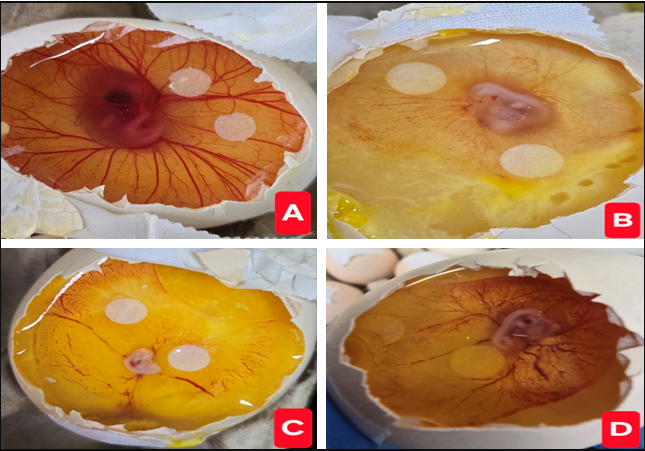
Background: Angiogenesis plays a crucial role in the progression of cancer and other angiogenesis-dependent disorders. Natural products are an important source of novel anti-angiogenic agents. Sclareol, a naturally occurring labdane diterpene, has attracted interest because of its diverse pharmacological properties; however, its anti-angiogenic potential remains poorly understood. Objective: The objective of this study is to investigate the anti-angiogenic activity of sclareol in ex vivo and in vivo models. Methods: Anti-angiogenic activity was investigated ex vivo using the rat aortic ring (RAR) and in vivo chick chorioallantoic membrane (CAM) assays. In the RAR assay, thoracic aortic rings from male albino rats were treated with sclareol (6.25–200 µg/mL). Suramin (100 µg/mL) and 1% DMSO served as positive and negative controls, respectively. Microvessel outgrowth inhibition and the half-maximal inhibitory concentration (IC₅₀) were determined from dose-response analysis. In the CAM assay, fertilized chicken eggs were treated with sclareol (0.25 and 0.5 mg/mL), and anti-angiogenic activity was measured. Results: Sclareol inhibited microvessel outgrowths in a concentration-dependent manner, producing 91.28±1.51% inhibition at 100 µg/mL compared with 98.22±1.22% for suramin (IC₅₀=32.31 µg/mL; p<0.05). In the CAM assay, sclareol inhibited neovascularization with avascular inhibition zones of 10.33±1.75 mm and 7.16±0.75 mm at 0.5 and 0.25 mg/mL, respectively (p<0.01). Conclusions: Sclareol demonstrated potent concentration-dependent anti-angiogenic activity in both ex vivo and in vivo models, indicating its potential as a promising natural anti-angiogenic agent and supporting further investigation for the management of cancer and other angiogenesis-dependent disorders.
Downloads
References
Brown KJ, Maynes SF, Bezos A, Maguire DJ, Ford MD, Parish CR. A novel in vitro assay for human angiogenesis. Lab Invest. 1996;75(4):539-555. PMID: 8874385.
Nicosia RF, Lin YJ, Hazelton D, Qian X. Endogenous regulation of angiogenesis in the rat aorta model. Role of vascular endothelial growth factor. Am J Pathol. 1997;151(5):1379-1386. PMID: 9358764.
West DC, Thompson WD, Sells PG, Burbridge MF. Angiogenesis assays using chick chorioallantoic membrane. Methods Mol Med. 2001;46:107-29. doi: 10.1385/1-59259-143-4:107.
Bocci G, Danesi R, Benelli U, Innocenti F, Di Paolo A, Fogli S, et al. Inhibitory effect of suramin in rat models of angiogenesis in vitro and in vivo. Cancer Chemother Pharmacol. 1999;43(3):205-212. doi: 10.1007/s002800050885.
Newman DJ, Cragg GM. Natural Products as Sources of New Drugs over the Nearly Four Decades from 01/1981 to 09/2019. J Nat Prod. 2020;83(3):770-803. doi: 10.1021/acs.jnatprod.9b01285.
Li R, Song X, Guo Y, Song P, Duan D, Chen ZS. Natural products: A promising therapeutics for targeting tumor angiogenesis. Front Oncol. 2021;11:772915. doi: 10.3389/fonc.2021.772915
Azevedo T, Ferreira T, Peña-Corona SI, Cortes H, Silva-Reis R, Gil da Costa RM, et al. Natural products-based antiangiogenic agents: New frontiers in cancer therapy. Food Front. 2024;5(6):2423-2466. doi: 10.1002/fft2.466.
Jan S, Khaliq T, Sultan P, Hassan QP, Gupta S, Ahmed Z. Salvia sclarea: A comprehensive review of its pharmacology, phytochemistry, ethnobotany and traditional uses. Curr Plant Biol. 2026;47:100604. doi:10.1016/j.cpb.2026.100604.
Zhou J, Xie X, Tang H, Peng C, Peng F. The bioactivities of sclareol: A mini review. Front Pharmacol. 2022;13:1014105. doi: 10.3389/fphar.2022.1014105.
Majidpoor J, Mortezaee K. Angiogenesis as a hallmark of solid tumors - clinical perspectives. Cell Oncol (Dordr). 2021;44(4):715-737. doi: 10.1007/s13402-021-00602-3.
Ozel I, Duerig I, Domnich M, Lang S, Pylaeva E, Jablonska J. The good, the bad, and the ugly: Neutrophils, angiogenesis, and cancer. Cancers (Basel). 2022;14(3):536. doi: 10.3390/cancers14030536.
Jalil ZH, Sahib HB. Antiangiogenic activity of quinine alone and in combination with vitamin C in both ex vivo and in vivo assays. Asian Pac J Cancer Prev. 2022;23(12):4185-4192. doi: 10.31557/APJCP.2022.23.12.4185.
Alasvand MV, Ambra R, Hedayati E, Kooti W, Peluso I. Antiangiogenic effect of alkaloids. Oxid Med Cell Longev. 2019;2019:9475908. doi: 10.1155/2019/9475908.
Acquaviva R, Malfa GA, Loizzo MR, Xiao J, Bianchi S, Tundis R. Advances on natural abietane, labdane and clerodane diterpenes as anti-cancer agents: Sources and mechanisms of action. Molecules. 2022;27(15):4791. doi: 10.3390/molecules27154791.
Mahaira LG, Tsimplouli C, Sakellaridis N, Alevizopoulos K, Demetzos C, Han Z, et al. The labdane diterpene sclareol (labd-14-ene-8, 13-diol) induces apoptosis in human tumor cell lines and suppression of tumor growth in vivo via a p53-independent mechanism of action. Eur J Pharmacol. 2011;666(1-3):173-182. doi: 10.1016/j.ejphar.2011.04.065.
Afshari H, Nourbakhsh M, Salehi N, Mahboubi-Rabbani M, Zarghi A, Noori S. STAT3-mediated apoptotic-enhancing function of sclareol against breast cancer cells and cell sensitization to cyclophosphamide. Iran J Pharm Res. 2020;19(1):398-412. doi: 10.22037/ijpr.2020.112587.13843.
Chen HL, Gong JY, Lin SC, Li S, Chiang YC, Hung JH, et al. Effects of sclareol against small cell lung carcinoma and the related mechanism: in vitro and in vivo studies. Anticancer Res. 2020;40(9):4947-4960. doi: 10.21873/anticanres.14498.
Rah B, Shafarin J, Hamad M, Muhammad JS. Sclareol induces cell cycle arrest and ROS-mediated apoptosis and ferroptosis in lung adenocarcinoma cells. J Biochem Mol Toxicol. 2024;38(1):e23563. doi: 10.1002/jbt.23563.
Kapoor A, Chen CG, Iozzo RV. A simplified aortic ring assay: A useful ex vivo method to assess biochemical and functional parameters of angiogenesis. Matrix Biol Plus. 2020;6-7:100025. doi: 10.1016/j.mbplus.2020.100025.
Pesenti E, Sola F, Mongelli N, Grandi M, Spreafico F. Suramin prevents neovascularisation and tumour growth through blocking of basic fibroblast growth factor activity. Br J Cancer. 1992;66(2):367-372. doi: 10.1038/bjc.1992.272.
Gagliardi A, Hadd H, Collins DC. Inhibition of angiogenesis by suramin. Cancer Res. 1992;52(18):5073-5075. PMID: 1381276.
Middaugh CR, Mach H, Burke CJ, Volkin DB, Dabora JM, Tsai PK, et al. Nature of the interaction of growth factors with suramin. Biochemistry. 1992;31(37):9016-9024. doi: 10.1021/bi00152a044.
Vandghanooni S, Eskandani M, Montazeri V, Halimi M, Babaei H. Sclareol inhibits hypoxia-inducible factor-1α accumulation and induces apoptosis in hypoxic cancer cells. Adv Pharm Bull. 2022;12(3):593-602. doi: 10.34172/apb.2022.062.
Afshari H, Nourbakhsh M, Salehi N, Mahboubi-Rabbani M, Zarghi A, Noori S. STAT3-mediated apoptotic-enhancing function of sclareol against breast cancer cells and cell sensitization to cyclophosphamide. Iran J Pharm Res. 2020;19(1):398-412. doi: 10.22037/ijpr.2020.112587.13843.
Tang L, Mei X, Ye M, Liu Y, Huang Y, Yu J, et al. Sclareol ameliorates liver injury by inhibiting nuclear factor-kappa B/NOD-like receptor protein 3-mediated inflammation and lipid metabolism disorder in diabetic mice. Int J Immunopathol Pharmacol. 2023;37:3946320231223644. doi: 10.1177/03946320231223644.
Wan Z, Hirche C, Fricke F, Dragu A, Will PA. Chick chorioallantoic membrane as an in vivo model for the study of angiogenesis and lymphangiogenesis. J Vasc Res. 2025;62(2):109-120. doi: 10.1159/000542875.
Fernandes LA, Magalhães GRI, Carreira ACO. Assays of angiogenic potential using quail and chicken chorioallantoic membrane (CAM). Curr Protoc. 2025;5(12):e70223. doi: 10.1002/cpz1.70223.
Bhatnagar S, Gill HM, Arava SN, Bharti I, Singh PK, Srivastava N, et al. Evaluating the antiangiogenic potential of Clerodendrum infortunatum Linn. through chorioallantoic membrane image analysis. Pharmacol Res Nat Prod. 2026;10:100476. doi: 10.1016/j.prenap.2025.100476.
Seal R, Habiba U, Mandal D, Karmakar A. Comparative evaluation of anti-angiogenic potential of four medicinal plant extracts using chick embryo chorioallantoic membrane (Cam) assay. Res Square [Preprint]. 2025 Jul 30. doi: 10.21203/rs.3.rs-6955217/v1.
Downloads
Published
How to Cite
Issue
Section
License
Copyright (c) 2026 Al-Rafidain Journal of Medical Sciences ( ISSN 2789-3219 )

This work is licensed under a Creative Commons Attribution-NonCommercial-ShareAlike 4.0 International License.
Published by Al-Rafidain University College. This is an open access journal issued under the CC BY-NC-SA 4.0 license (https://creativecommons.org/licenses/by-nc-sa/4.0/).