Clinical and Electrophysiological Outcomes of Carpal Tunnel Release Surgery
DOI:
https://doi.org/10.54133/ajms.v11i2.3137Keywords:
Carpal tunnel syndrome, Electrophysiology, Motor nerve, NCS, Sensory nerveAbstract
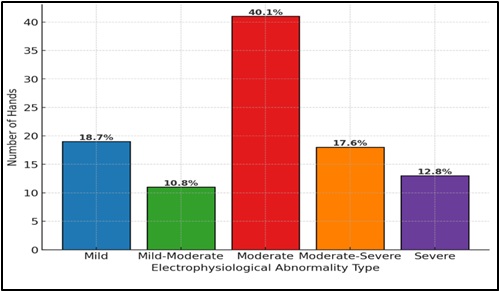
Background: Carpal Tunnel Syndrome (CTS) is the most prevalent entrapment neuropathy that often requires surgical intervention in severe cases. Objective: To evaluate the clinical and electrophysiological outcomes of carpal tunnel release surgery. Methods: In this retrospective cohort study, 102 hands of 84 patients, who underwent carpal tunnel release (CTR) for CTS, were included. Patients were stratified into three groups (mild, moderate, and severe) based on symptom presentation and preoperative nerve conduction studies (NCS). NCS findings further categorized median nerve dysfunction into five electrodiagnostic grades (mild to severe). All patients received division of the flexor retinaculum without adjunctive neurolysis. Postoperative clinical and electrophysiological reassessments were performed at a mean follow‑up of 14 months to assess recovery. Results: Baseline severity was correlated negatively with recovery. Patients with mild disease (100%) were completely clinically and electrophysiologically normal, whereas 11 (91.7%) with moderate disease had significant improvement, with one patient remaining with residual weakness, and 5 of 7 patients with severe disease improved, with 2 patients having persistent motor deficits at a mean postoperative follow-up of 14 months (41.6%). Intraoperative findings revealed 9 pseudoneuromas (28.1%), 7 cases of abnormal muscle anatomy, 6 cases of Colles' fracture malunion, 7 cases of diabetes/hypothyroidism, 2 cases of rheumatoid arthritis, and 44% of idiopathic cases. Conclusions: Older patients should receive early treatment when NCS is crucial, for both proper diagnosis and therapeutic planning. Standard flexor retinaculum release provides effective treatment for most of the population; however, severe cases might require additional therapeutic methods.
Downloads
References
Zaki HA, Shaban E, Salem W, Bilal F, Fayed M, Hendy M, et al. A Comparative analysis between ultrasound and electromyographic and nerve conduction studies in diagnosing carpal tunnel syndrome (CTS): A systematic review and meta-analysis. Cureus. 2022;14:e30476. doi: 10.7759/cureus.30476.
Lee K, Park JM, Yoon SY, Kim MS, Kim YW, Shin JI, et al. Ultrasound-guided nerve hydrodissection for the management of carpal tunnel syndrome: A systematic review and network meta-analysis. Yonsei Med J. 2025;66:111-120. doi: 10.3349/ymj.2024.0089.
Dec P, Zyluk A. Bilateral carpal tunnel syndrome - A review. Neurol Neurochir Pol. 2018;52:79-83. doi: 10.1016/j.pjnns.2017.09.009.
Dahlin LB, Zimmerman M, Calcagni M, Hundepool CA, van Alfen N, Chung KC. Carpal tunnel syndrome. Nat Rev Dis Primers. 2024;10:37. doi: 10.1038/s41572-024-00521-1.
Riccò M, Cattani S, Signorelli C. Personal risk factors for carpal tunnel syndrome in female visual display unit workers. Int J Occup Med Environ Health. 2016;29:927-936. doi: 10.13075/ijomeh.1896.00781.
Kadhim ZME, Jabir B. The incidence of ulnar nerve subluxation in patients with ulnar neuropathy at the elbow and healthy control: A clinical, electrodiagnostic, and ultrasonographic study. Med J Babylon. 2023;20:477-480. doi: 10.4103/mjbl.Mjbl_471_23.
Binsaleem S. Median nerve entrapment neuropathy: a review on the pronator syndrome. JSES Rev Rep Tech. 2025;5:70-78. doi: 10.1016/j.xrrt.2024.10.001.
Meyers A, Annunziata MJ, Rampazzo A, Bassiri Gharb B. A systematic review of the outcomes of carpal ligament release in severe carpal tunnel syndrome. J Hand Surg Am. 2023;48:408.e1-.e18. doi: 10.1016/j.jhsa.2021.11.015.
Vernick RC, Beckwitt CH, Fowler JR. Subjective and objective differences in patients with unilateral and bilateral carpal tunnel syndrome and the role of obesity in syndrome severity. Plastic Reconstruct Surg. 2024; 153(2):423-429. doi: 10.1097/PRS.0000000000010773.
Al-Joda BMS, Al-Hindy HAM, Mousa MJ. Exploring the role of vitamin D2, parathyroid hormone, and C-peptides as biomarkers in diabetic neuropathy development. Med J Babylon. 2024;21(2):438-443. doi: 10.4103/MJBL.MJBL_1568_23.
Al-Shimmery AHS, Mahdi ZA, Abdul-Amir HM, Al-Mammori RTO, Mokif TA, Al-Dahmoshi HOM, e al. Immunological study of IFN-γ, ICAM-4, and vitamin D3 markers among gastrointestinal tumor patients in Babylon province, Iraq. Asian Pac J Cancer Prev. 2023;24:301-305. doi: 10.31557/apjcp.2023.24.1.301.
Ramadan GM, Makki HAA, Mousa MJ, Al-Sadi HI. Evaluation of transforming growth factor-beta 1 (TGFβ1) levels in cases with multiple myeloma: Case-control study among Iraqis. J ReAttach Ther Dev Diversities. 2022;5:516-523.
Saito Y, Chikenji T, Ozasa Y, Fujimiya M, Yamashita T, Gingery A, et al. PDGFR signaling mediates hyperproliferation and fibrotic responses of subsynovial connective tissue cells in idiopathic carpal tunnel syndrome. Sci Rep. 2017;7:16192. doi: 10.1038/s41598-017-16443-w.
Wang Y, Guo L, Yin X, McCarthy EC, Cheng MI, Hoang AT. Pathogenic TNF-α drives peripheral nerve inflammation in an Aire-deficient model of autoimmunity. Proc Natl Acad Sci U S A. 2022;119. doi: 10.1073/pnas.2114406119.
Alrayes MS, Altawili M, Alsaffar MH, Alfarhan GZ, Owedah RJ, Bodal IS, et al. Surgical interventions for the management of carpal tunnel syndrome: A narrative review. Cureus. 2024;16:e55593. doi: 10.7759/cureus.55593.
Wiberg A, Smillie RW, Dupré S, Schmid AB, Bennett DL, Furniss D. Replication of epidemiological associations of carpal tunnel syndrome in a UK population-based cohort of over 400,000 people. J Plast Reconstr Aesthet Surg. 2022;75(3):1034-1040. doi: 10.1016/j.bjps.2021.11.025.
English JH, Gwynne-Jones DP. Incidence of carpal tunnel syndrome requiring surgical decompression: A 10.5-year review of 2,309 patients. J Hand Surg Am. 2015;40:2427-2434. doi: 10.1016/j.jhsa.2015.07.029.
Ganjoo S, Kaul D, Shah PA. Carpal tunnel syndrome in females: pregnancy and lactation the major risk factors. Int J Reprod Contracept Obstet Gynecol. 2018;7:3512-3515. doi: 10.18203/2320-1770.ijrcog20183366.
Sonoo M, Menkes DL, Bland JDP, Burke D. Nerve conduction studies and EMG in carpal tunnel syndrome: Do they add value? Clin Neurophysiol Pract. 2018;3:78-88. doi: 10.1016/j.cnp.2018.02.005.
Downloads
Published
How to Cite
Issue
Section
License
Copyright (c) 2026 Al-Rafidain Journal of Medical Sciences ( ISSN 2789-3219 )

This work is licensed under a Creative Commons Attribution-NonCommercial-ShareAlike 4.0 International License.
Published by Al-Rafidain University College. This is an open access journal issued under the CC BY-NC-SA 4.0 license (https://creativecommons.org/licenses/by-nc-sa/4.0/).