Assessment of Efficacy and Patient Satisfaction with Fractional CO₂ Laser in Vitiligo Treatment
DOI:
https://doi.org/10.54133/ajms.v11i1.3008Keywords:
Ablative laser therapy, Fractional CO₂ laser, Non-segmental vitiligo , Patient satisfaction , Repigmentation , VitiligoAbstract
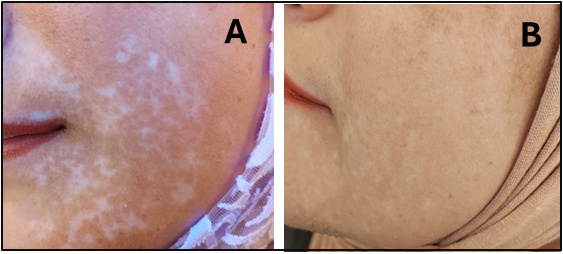
Background: Vitiligo is a common acquired depigmenting disorder with substantial psychosocial consequences. Conventional treatments, topical immunomodulators, phototherapy, and surgical techniques often yield partial or slow repigmentation, and relapse remains frequent. Objective: To assess the therapeutic efficacy of fractional carbon dioxide laser for vitiligo and to evaluate patient satisfaction. Method: A single-arm interventional study was conducted in a private dermatology clinic in Iraq, from February 2024 to February 2025, enrolling consecutive adults with stable, non-segmental vitiligo of Fitzpatrick skin phototypes III–IV. Treatment consisted of fractional ablative carbon dioxide laser sessions scheduled every two to three weeks. Outcomes were evaluated at three and six months from the first session. Results: Participants completed a median of six fractional CO₂ laser sessions (range 4–7). At three months, 50.0% achieved an excellent response, 26.7% a moderate response, and 23.3% a poor response. The mean patient-reported satisfaction score at three months was 3.6±1.0. By six months, 60.0% remained relapse-free. Compared with relapsers, non-relapsers were more often male (72.2% vs. 41.7%; p=0.018), had shorter disease duration (3.0±2.2 vs. 4.8±3.4 years; p=0.026), and reported higher satisfaction (4.0±0.6 vs. 2.9±1.1; p<0.001). The lesion site was highly correlated with outcomes (overall p<0.001). Conclusions: The fractional carbon dioxide laser resulted in statistically meaningful repigmentation and was tolerated reasonably well, with favorable patient-reported satisfaction. Our findings supported site-specific counseling and treatment duration, as site-specific results differed by lesion and duration of disease.
Downloads
References
Bergqvist C, Ezzedine K. Vitiligo: a review. Dermatology. 2020;236:571-592. doi: 10.1159/000506103. DOI: https://doi.org/10.1159/000506103
Qiu Y, Su X, Chen J, Jiang S, Tang X, He Y, et al. Recent advances in vitiligo treatment. Immunotargets Ther. 2026;15:577653. doi: 10.2147/ITT.S577653. DOI: https://doi.org/10.2147/ITT.S577653
Raheel MFS, Snoubar Y, Mosbah WS. Being female with vitiligo disease in traditional societies within North Africa. BioPsychoSocial Med. 2024;18:1. doi: 10.1186/s13030-023-00293-x. DOI: https://doi.org/10.1186/s13030-024-00299-4
Bibeau K, Ezzedine K, Harris JE, van Geel N, Grimes P, Parsad D, et al. Mental health and psychosocial quality-of-life burden among patients with vitiligo: findings from the global VALIANT study. JAMA Dermatol. 2023;159:1124-1128. doi: 10.1001/jamadermatol.2023.2787. DOI: https://doi.org/10.1001/jamadermatol.2023.2787
Wang X, Wu W, Chen J, Li C, Li S. Management of the refractory vitiligo patient: current therapeutic strategies and future options. Front Immunol. 2024;14:1294919. doi: 10.3389/fimmu.2023.1294919. DOI: https://doi.org/10.3389/fimmu.2023.1294919
Bishnoi A, Parsad D. Phototherapy for vitiligo: a narrative review on the clinical and molecular aspects, and recent literature. Photodermatol Photoimmunol Photomed. 2024;40:e12968. doi: 10.1111/phpp.12968. DOI: https://doi.org/10.1111/phpp.12968
Zhang L, Zhang J, Wang X, Zhao Z, Li Z, Miao G, et al. Clinical efficacy of CO2 fractional laser combined with compound betamethasone in treating vitiligo and its impact on inflammatory factors. Front Med. 2024;11:1408409. doi: 10.3389/fmed.2024.1408409. DOI: https://doi.org/10.3389/fmed.2024.1408409
Sinha S, Agrawal D. Medical management of vitiligo: a narrative review. Pigment Int. 2025;12:4-19. doi: 10.4103/pigmentinternational.pigmentinternational_12_24. DOI: https://doi.org/10.4103/pigmentinternational_12_24
Sun J, Yan M, Xu M, Wang T, Li J. Meta-analysis of the efficacy of 308 nm excimer light combined with CO2 fractional laser in the treatment of vitiligo on trunk part. Medicine. 2025;104:e44377. doi: 10.1097/MD.0000000000044377. DOI: https://doi.org/10.1097/MD.0000000000044377
Kim HJ, Hong ES, Cho SH, Lee JD, Kim HS. Fractional carbon dioxide laser as an "add-on" treatment for vitiligo: a meta-analysis with systematic review. Acta Derm Venereol. 2018;98. doi: 10.2340/00015555-2965. DOI: https://doi.org/10.2340/00015555-2836
Rokni GR, Malekan M, Azade S, Beyzaee AM, Heydari K, Fallah S, et al. Fractional CO2 laser combined with narrow-band ultraviolet B (NB-UVB) phototherapy versus NB-UVB monotherapy in vitiligo patients: prospective, self-controlled, and randomized trial. Lasers Med Sci. 2025;40:19. doi: 10.1007/s10103-024-04218-6. DOI: https://doi.org/10.1007/s10103-025-04293-2
Zhu B, Liu C, Zhang L, Wang J, Chen M, Wei Y. Comparison of NB‐UVB combination therapy regimens for vitiligo: a systematic review and network meta‐analysis. J Cosmet Dermatol. 2023;22:1083-1098. doi: 10.1111/jocd.15582. DOI: https://doi.org/10.1111/jocd.15534
Prasanna H, Srinivas RT, Kuppuswamy SK, Keloji H, Ravikumar PT. A comparative study of fractional CO2 laser with topical triamcinolone acetonide versus intralesional triamcinolone acetonide in the treatment of alopecia areata. J Cutan Aesthet Surg. 2024;17(1):34-40. doi: 10.4103/JCAS.JCAS_31_23. DOI: https://doi.org/10.4103/JCAS.JCAS_31_23
Khalili M, Solhjou S, Amiri R, Rukerd MRZ, Aflatoonian M. Triple combination of fractional carbon dioxide laser, 308-nm excimer lamp, and platelet-rich plasma in refractory vitiligo: a randomized split-body comparative study. J Cutan Aesthet Surg. 2025;18:34. doi: 10.4103/JCAS.JCAS_110_24. DOI: https://doi.org/10.25259/JCAS_16_2024
Yahya NA, Al Hamamy HR. A comparative study of efficacy of ablative fractional CO2 laser plus 5% 5-fluorouracil cream versus monotherapy with ablative fractional CO2 laser or 5% 5-fluorouracil cream in treatment of stable vitiligo. Arab Board Med J. 2025;26:77-87. doi: 10.4103/abmj.abmj_12_24. DOI: https://doi.org/10.4103/abmj.abmj_33_24
Pathak GN, Chandy RJ, Naini V, Feldman SR, Rao BK. Quality of life assessments utilized in vitiligo clinical trials. Dermatol Ther. 2023;2023:9948769. doi: 10.1155/2023/9948769. DOI: https://doi.org/10.1155/2023/9948769
Sharma AN, Patel BC. Laser Fitzpatrick skin type recommendations. 2023 Mar 6. In: StatPearls [Internet]. Treasure Island (FL): StatPearls Publishing; 2026. PMID: 32491558.
Post NF, Ezekwe N, Narayan VS, Bekkenk MW, Van Geel N, Hamzavi I, et al. The use of lasers in vitiligo, an overview. J Eur Acad Dermatol Venereol. 2022;36:779-789. doi: 10.1111/jdv.17838. DOI: https://doi.org/10.1111/jdv.18005
Batchelor JM, Tan W, Tour S, Yong A, Montgomery AA, Thomas KS. Validation of the vitiligo noticeability scale: a patient‐reported outcome measure of vitiligo treatment success. Br J Dermatol. 2016;174:386-394. doi: 10.1111/bjd.14207. DOI: https://doi.org/10.1111/bjd.14208
Mansouri P, Rahbar M, Nilforoushzadeh MA, Shati M. Exploring the efficacy of fractional carbon dioxide laser as an add-on combination to conventional therapies for treatment-resistant vitiligo (a review article). J Lasers Med Sci. 2023;14:e51. doi: 10.34172/jlms.2023.51. DOI: https://doi.org/10.34172/jlms.2023.51
Tour SK, Thomas KS, Walker DM, Leighton P, Yong ASW, Batchelor JM. Survey and online discussion groups to develop a patient-rated outcome measure on acceptability of treatment response in vitiligo. BMC Dermatol. 2014;14:10. doi: 10.1186/1471-5945-14-10. DOI: https://doi.org/10.1186/1471-5945-14-10
Lei TC, Hearing VJ. Deciphering skin re-pigmentation patterns in vitiligo: an update on the cellular and molecular events involved. Chin Med J. 2020;133:1231-1238. doi: 10.1097/CM9.0000000000000783. DOI: https://doi.org/10.1097/CM9.0000000000000794
Gan EY, Gahat T, Cario‐André M, Seneschal J, Ezzedine K, Taieb A. Clinical repigmentation patterns in paediatric vitiligo. Br J Dermatol. 2016;175:555-560. doi: 10.1111/bjd.14530. DOI: https://doi.org/10.1111/bjd.14635
Falabella R. Vitiligo and the melanocyte reservoir. Indian J Dermatol. 2009;54:313-318. doi: 10.4103/0019-5154.57601. DOI: https://doi.org/10.4103/0019-5154.57604
Speeckaert R, van Geel N. Distribution patterns in generalized vitiligo. J Eur Acad Dermatol Venereol. 2014;28:755-762. doi: 10.1111/jdv.12134. DOI: https://doi.org/10.1111/jdv.12171
Bae JM, Hann S-K. Laser treatments for vitiligo. Med Lasers. 2016;5:63-70. doi: 10.25289/ML.2016.5.2.63. DOI: https://doi.org/10.25289/ML.2016.5.2.63
Ju HJ, Bae JM, Lee RW, Kim SH, Parsad D, Pourang A, et al. Surgical interventions for patients with vitiligo: a systematic review and meta-analysis. JAMA Dermatol. 2021;157:307-316. doi: 10.1001/jamadermatol.2020.5756. DOI: https://doi.org/10.1001/jamadermatol.2020.5756
Altalhab S, AlJasser MI, Mulekar SV, Al Issa A, Mulekar S, Diaz J, et al. Six‐year follow‐up of vitiligo patients successfully treated with autologous non‐cultured melanocyte–keratinocyte transplantation. J Eur Acad Dermatol Venereol. 2019;33:1172-1176. doi: 10.1111/jdv.15418. DOI: https://doi.org/10.1111/jdv.15411
Xu W, Qiu Z, Li C, Wang Y, Lin M, Liu Y, et al. Recurrence and risk factors in cured patients with vitiligo: a real‐life single‐center retrospective study. J Cosmet Dermatol. 2023;22:1680-1684. doi: 10.1111/jocd.15647. DOI: https://doi.org/10.1111/jocd.15637
Liu B, Shen J, Li J, Tian B, Zhou B, Gui J, et al. Candidate approaches for predicting vitiligo recurrence: an effective model and biomarkers. Front Immunol. 2025;16:1468665. doi: 10.3389/fimmu.2025.1468665. DOI: https://doi.org/10.3389/fimmu.2025.1468665
Manzoor M, Tahir K, Amin U, Bashir S, Altaf O, Naeem N. Efficacy of fractional carbon dioxide laser versus 0.1% tacrolimus cream in the treatment of segmental vitiligo. J Pak Assoc Dermatol. 2023;33(3):943-948. doi: 10.66344/jpad.33.3.2023.2303.
Feng X, Jiang S, Zou X, Deng Y, Xie J. Efficacy and safety of combined platelet‐rich plasma with fractional laser for adult patients with vitiligo: a systematic review and meta‐analysis of randomized controlled trials. J Cosmet Dermatol. 2025;24:e70245. doi: 10.1111/jocd.70245. DOI: https://doi.org/10.1111/jocd.70245
Pérez Rivera F. Laser CO2 scar treatment for moderate to high Fitzpatrick skin types in patients with acne sequelae from Argentina: treatment characteristics, evaluation of results and satisfaction. Eur J Plast Surg. 2025;48:6. doi: 10.1007/s00238-024-02265-2. DOI: https://doi.org/10.1007/s00238-024-02262-6
Downloads
Published
How to Cite
Issue
Section
License
Copyright (c) 2026 Al-Rafidain Journal of Medical Sciences ( ISSN 2789-3219 )

This work is licensed under a Creative Commons Attribution-NonCommercial-ShareAlike 4.0 International License.
Published by Al-Rafidain University College. This is an open access journal issued under the CC BY-NC-SA 4.0 license (https://creativecommons.org/licenses/by-nc-sa/4.0/).