Efficacy of a SIRT1 Aptamer as an Anti-Angiogenic and Antioxidant Agent in in vitro, ex vivo, and in vivo Models
DOI:
https://doi.org/10.54133/ajms.v11i1.2977Keywords:
Angiogenesis, Antioxidant activity, Chick chorioallantoic membrane, HUVEC, Rat aortic ring assay, SIRT1 aptamerAbstract
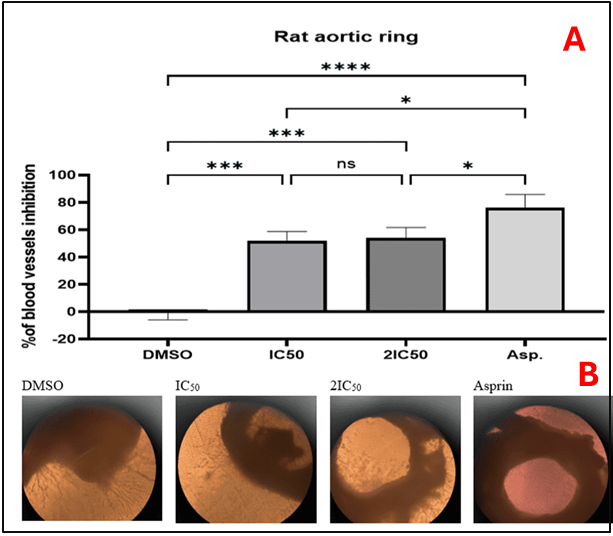
Background: Angiogenesis and oxidative stress are closely related processes that facilitate pathological vascular remodeling and cancer progression. Given that sirtuin 1 (SIRT1) modulates endothelial function, redox balance, and angiogenic remodeling in a context-dependent manner. Objective: To investigate the anti-angiogenic and antioxidant activity of a circular SIRT1 aptamer in multidesign settings. Methods: The endothelial response was evaluated in HUVECs via the XTT assay; antioxidant activity was assessed using the DPPH radical scavenging assay; ex vivo angiogenesis was measured in the rat aortic ring model; and in vivo validation was conducted with the chick chorioallantoic membrane (CAM) assay. Results: The impact of the aptamer on HUVEC was concentration- and time-dependent, with IC50 values of 3.910, 3.103, and 1.337 µM at 24, 48, and 72 hours, respectively. Furthermore, the aptamer exhibited substantial radical-scavenging activity in the DPPH assay, representing an IC50 of 0.0499 µM. It also inhibited microvessel sprouting in the rat aortic ring assay, with an IC50 of 0.613 µM, and suppressed CAM vascularization in a dose-dependent manner; the highest concentration tested produced an effect comparable to that of aspirin. These findings indicate that the circular SIRT1 aptamer possesses anti-angiogenic properties across in vitro, ex vivo, and in vivo models, in addition to its antioxidant capacity within cell-free systems. Conclusions: This aptamer has potential to act as a bioactive oligonucleotide scaffold for angiogenic applications; however, further research is necessary to determine its target specificity and translational significance.
Downloads
References
Liu ZL, Chen HH, Zheng LL, Sun LP, Shi L. Angiogenic signaling pathways and anti-angiogenic therapy for cancer. Signal Transduct Targeted Ther. 2023;8(1):198. doi: 10.1038/s41392-023-01460-1. DOI: https://doi.org/10.1038/s41392-023-01460-1
Citrin KM, Chaube B, Fernández-Hernando C, Suárez Y. Intracellular endothelial cell metabolism in vascular function and dysfunction. Trends Endocrinol Metab. 2025;36(8):744-755. doi: 10.1016/j.tem.2024.11.004. DOI: https://doi.org/10.1016/j.tem.2024.11.004
Zhang R, Yao Y, Gao H, Hu X. Mechanisms of angiogenesis in tumour. Front Oncol. 2024;14:2024. doi: 10.3389/fonc.2024.1359069. DOI: https://doi.org/10.3389/fonc.2024.1359069
Aldeen SS, Alabbassi MG. Histopathological study of the effect of sunitinib in treatment of retinal angiogenesis induced by VEGF 165 in rabbits’ eyes. Al Mustansiriyah J Pharm Sci. 2018;18(2):170-181. doi: 10.32947/ajps.v18i2.491. DOI: https://doi.org/10.32947/ajps.v18i2.491
Guo Z, Jing X, Sun X, Sun S, Yang Y, Cao Y, et al. Tumor angiogenesis and anti-angiogenic therapy. Chinese Med J. 2024;137(17):2043-2051. doi: 10.1097/CM9.0000000000003231. DOI: https://doi.org/10.1097/CM9.0000000000003231
Folkman J. Tumor angiogenesis: Therapeutic implications. New Engl J Med. 1971;285(21):1182-1186. doi: 10.1056/NEJM197111182852108. DOI: https://doi.org/10.1056/NEJM197111182852108
Cao Y. Angiogenesis in diseases: A half-century excursion from the initial therapeutic concept to current clinical benefits. Chinese Med J. 2024;137(6):636-763. doi: 10.1097/cm9.0000000000003002. DOI: https://doi.org/10.1097/CM9.0000000000003002
Edatt L, Poyyakkara A, Raji GR, Ramachandran V, Shankar SS, Kumar VS. Role of sirtuins in tumor angiogenesis. Front Oncol. 2020;9:1516. doi: 10.3389/fonc.2019.01516. DOI: https://doi.org/10.3389/fonc.2019.01516
Silva Teixeira C, Cerqueira N, Gomes P, Sousa S. A molecular perspective on sirtuin activity. Int J Mol Sci. 2020;21:1-20. doi: 10.3390/ijms21228609. DOI: https://doi.org/10.3390/ijms21228609
Kumar J, Kumar S. Sirtuin1 in vascular endothelial function, an overview. Epigenetics. 2022;17(9):953-969. doi: 10.1080/15592294.2021.1975936. DOI: https://doi.org/10.1080/15592294.2021.1975936
Carafa V, Altucci L, Nebbioso A. Dual tumor suppressor and tumor promoter action of sirtuins in determining malignant phenotype. Front Pharmacol. 2019;10:2019. doi: 10.3389/fphar.2019.00038. DOI: https://doi.org/10.3389/fphar.2019.00038
Domsicova M, Korcekova J, Poturnayova A, Breier A. New insights into aptamers: An alternative to antibodies in the detection of molecular biomarkers. Int J Mol Sci. 2024;25(13):6833. doi: 10.3390/ijms25136833. DOI: https://doi.org/10.3390/ijms25136833
Fallah A, Fooladi AAI, Havaei SA, Mahboobi M, Sedighian H. Recent advances in aptamer discovery, modification and improving performance. Biochem Biophys Rep. 2024;40:101852. doi: 10.1016/j.bbrep.2024.101852. DOI: https://doi.org/10.1016/j.bbrep.2024.101852
Al-Sudani B, Ragazzon-Smith AH, Aziz A, Alansari R, Ferry N, Krstic-Demonacos M, et al. Circular and linear: a tale of aptamer selection for the activation of SIRT1 to induce death in cancer cells. RSC Adv. 2020;10(73):45008-45018. doi: 10.1039/D0RA07857C. DOI: https://doi.org/10.1039/D0RA07857C
Keefe AD, Pai S, Ellington A. Aptamers as therapeutics. Nat Rev Drug Discov. 2010;9(7):537-550. doi: 10.1038/nrd3141. DOI: https://doi.org/10.1038/nrd3141
Chang N, Li J, Lin S, Zhang J, Zeng W, Ma G, et al. Emerging roles of SIRT1 activator, SRT2104, in disease treatment. Sci Rep. 2024;14(1):5521. doi: 10.1038/s41598-024-55923-8. DOI: https://doi.org/10.1038/s41598-024-55923-8
Salvagno M, Sterchele ED, Zaccarelli M, Mrakic-Sposta S, Welsby IJ, Balestra C, et al. Oxidative stress and cerebral vascular tone: The role of reactive oxygen and nitrogen species. Int J Mol Sci. 2024;25(5):3007. doi: 10.3390/ijms25053007. DOI: https://doi.org/10.3390/ijms25053007
Jin S, Kang PM. A systematic review on advances in management of oxidative stress-associated cardiovascular diseases. Antioxidants. 2024;13(8):923. doiI: 10.3390/antiox13080923. DOI: https://doi.org/10.3390/antiox13080923
Huang YJ, Nan GX. Oxidative stress-induced angiogenesis. J Clin Neurosci. 2019;63:13-16. doi: 10.1016/j.jocn.2019.02.019. DOI: https://doi.org/10.1016/j.jocn.2019.02.019
Medina-Leyte DJ, Domínguez-Pérez M, Mercado I, Villarreal-Molina MT, Jacobo-Albavera L. Use of human umbilical vein endothelial cells (HUVEC) as a model to study cardiovascular disease: A review. Appl Sci. 2020;10(3):938. doi: 10.3390/app10030938. DOI: https://doi.org/10.3390/app10030938
Aslantürk ÖS. In vitro cytotoxicity and cell viability assays: principles, advantages, and disadvantages. In: Larramendy ML, Soloneski S, (Eds.), Genotoxicity- A predictable risk to our actual world, InTech Open, 2018;2:64-80. doi: 10.5772/intechopen.71923. DOI: https://doi.org/10.5772/intechopen.71923
Priyanka Poonia PP, Junaid Niazi JN, Gagandeep Chaudhary GC, Kalia A. In-vitro antioxidant potential of Jasminum mesnyi Hance (leaves) extracts. Res J Pharm Biol Chem Sci. 2011;2(1):348-357. ISSN: 0975-8585.
Ramnik Singh RS, Narinder Singh NS, Saini B, Rao H. In vitro antioxidant activity of pet ether extract of black pepper. Indian J Pharmacol. 2008;40(4). doi: 10.4103/0253-7613.43160. DOI: https://doi.org/10.4103/0253-7613.43160
Ali MMS, Abdalah ME, Mshimesh BA-R. Phytochemical study and pharmacological activity of Terminalia chebula fruit extracts activity as dihydrofolate reductase enzyme inhibitors associated with antioxidant effect: In vitro study. Al Mustansiriyah J Pharm Sci. 2022;22(4):9-22. doi: 10.32947/ajps.v22i4.948. DOI: https://doi.org/10.32947/ajps.v22i4.948
Nicosia RF, Lin YJ, Hazelton D, Qian X. Endogenous regulation of angiogenesis in the rat aorta model. Role of vascular endothelial growth factor. Am J Pathol. 1997;151(5):1379. PMCID: 1858079.
Al-Zubaidy AA, Sahib HB, Sadiq MH. Anti-angiogenig activity of fenugreek extracts: in vivo and ex vivo study. Int J Pharm Sci Rev Res. 2016;36(2):184-189. Corpus ID: 89613085.
Mshimesh BAR, Falah Hassan I, Al-Shammari AM. Antiangiogeneic activity of Annona reticulata seeds extract. Iraqi J Cancer Med Genet. 2022;15(1):19-26. doi: 10.29409/ijcmg.v15i1.325. DOI: https://doi.org/10.29409/ijcmg.v15i1.325
Kennedy DC, Coen B, Wheatley AM, McCullagh KJ. Microvascular experimentation in the chick chorioallantoic membrane as a model for screening angiogenic agents including from gene-modified cells. Int J Mol sci. 2021;23(1):452. doi: 10.3390/ijms23010452. DOI: https://doi.org/10.3390/ijms23010452
Al-hassany H. Anti-angiogenic activity of Matricaria chamomilla flowers methanol extract-In vivo study. Int J Pharm Sci Rev Res. 2016;41(2):367-371.
Wolint P, Hofmann S, von Atzigen J, Böni R, Miescher I, Giovanoli P, et al. Standardization to characterize the complexity of vessel network using the aortic ring model. Int J Mol Sci. 2025;26(1):291. doi: 10.3390/ijms26010291. DOI: https://doi.org/10.3390/ijms26010291
Chastel T, Filiberti S, Mitola S, Ronca R, Turtoi A, Corsini M. Protocol for performing angiogenic and tumorigenic assays using the in ovo chick embryo chorioallantoic membrane model. STAR Protoc. 2025;6(1):103663. doi: 10.1016/j.xpro.2025.103663. DOI: https://doi.org/10.1016/j.xpro.2025.103663
Wan Z, Hirche C, Fricke F, Dragu A, Will PA. Chick chorioallantoic membrane as an in vivo model for the study of angiogenesis and lymphangiogenesis. J Vasc Res. 2025;62(2):109-120. doi: 10.1159/000542875. DOI: https://doi.org/10.1159/000542875
Nicosia RF. The aortic ring model of angiogenesis: a quarter century of search and discovery. J Cell Mol Med. 2009;13(10):4113-4136. doi: 10.1111/j.1582-4934.2009.00891.x. DOI: https://doi.org/10.1111/j.1582-4934.2009.00891.x
Lim JH, Lee YM, Chun YS, Chen J, Kim JE, Park JW. Sirtuin 1 modulates cellular responses to hypoxia by deacetylating hypoxia-inducible factor 1alpha. Mol Cell. 2010;38(6):864-878. doi: 10.1016/j.molcel.2010.05.023. DOI: https://doi.org/10.1016/j.molcel.2010.05.023
Joo HY, Yun M, Jeong J, Park ER, Shin HJ, Woo SR, et al. SIRT1 deacetylates and stabilizes hypoxia-inducible factor-1α (HIF-1α) via direct interactions during hypoxia. Biochem Biophys Res Commun. 2015;462(4):294-300. doi: 10.1016/j.bbrc.2015.04.119. DOI: https://doi.org/10.1016/j.bbrc.2015.04.119
Zhang H, He S, Spee C, Ishikawa K, Hinton DR. SIRT1 mediated inhibition of VEGF/VEGFR2 signaling by Resveratrol and its relevance to choroidal neovascularization. Cytokine. 2015;76(2):549-552. doi: 10.1016/j.cyto.2015.06.019. DOI: https://doi.org/10.1016/j.cyto.2015.06.019
Potente M, Ghaeni L, Baldessari D, Mostoslavsky R, Rossig L, Dequiedt F, et al. SIRT1 controls endothelial angiogenic functions during vascular growth. Genes Dev. 2007;21(20):2644-2658. doi: 10.1101/gad.435107. DOI: https://doi.org/10.1101/gad.435107
Bai J, Khajavi M, Sui L, Fu H, Tarakkad Krishnaji S, Birsner AE, et al. Angiogenic responses in a 3D micro-engineered environment of primary endothelial cells and pericytes. Angiogenesis. 2021;24(1):111-127. doi: 10.1007/s10456-020-09746-6. DOI: https://doi.org/10.1007/s10456-020-09746-6
Brown RM, Meah CJ, Heath VL, Styles IB, Bicknell R, (Eds.), Tube-forming assays. Angiogenesis protocols: Springer; 2016. p. 149-57. doi: 10.1007/978-1-4939-3628-1_9. DOI: https://doi.org/10.1007/978-1-4939-3628-1_9
Tetzlaff F, Fischer A. Human endothelial cell spheroid-based sprouting angiogenesis assay in collagen. Bio Protoc. 2018;8(17):e2995. doi: 10.21769/BioProtoc.2995. DOI: https://doi.org/10.21769/BioProtoc.2995
Vakhrushev IV, Nezhurina EK, Karalkin PA, Tsvetkova AV, Sergeeva NS, Majouga AG, et al. Heterotypic multicellular spheroids as experimental and preclinical models of sprouting angiogenesis. Biology. 2021;11(1):18. doi: 10.3390/biology11010018. DOI: https://doi.org/10.3390/biology11010018
Magdalena Radomska-Leśniewska D, Bałan BJ, Skopiński P. Angiogenesis modulation by exogenous antioxidants. Central Eur J Immunol. 2017;42(4):370-376. doi: 10.5114/ceji.2017.72804. DOI: https://doi.org/10.5114/ceji.2017.72804
Magar AG, Morya VK, Kwak MK, Oh JU, Noh KC. A molecular perspective on HIF-1α and angiogenic stimulator networks and their role in solid tumors: An update. Int J Mol Sci. 2024;25(6):3313. doi: 10.3390/ijms25063313. DOI: https://doi.org/10.3390/ijms25063313
Olmos Y, Sánchez-Gómez FJ, Wild B, García-Quintans N, Cabezudo S, Lamas S, et al. SirT1 regulation of antioxidant genes is dependent on the formation of a FoxO3a/PGC-1α complex. Antioxid Redox Signal. 2013;19(13):1507-1521. doi: 10.1089/ars.2012.4713. DOI: https://doi.org/10.1089/ars.2012.4713
Irwin DC, McCord JM, Nozik-Grayck E, Beckly G, Foreman B, Sullivan T, et al. A potential role for reactive oxygen species and the HIF-1alpha-VEGF pathway in hypoxia-induced pulmonary vascular leak. Free Radic Biol Med. 2009;47(1):55-61. doi: 10.1016/j.freeradbiomed.2009.03.027. DOI: https://doi.org/10.1016/j.freeradbiomed.2009.03.027
Hacker L, Sarsam E, Conway SJ, Hammond EM. A guide to reactive oxygen species in tumour hypoxia: measurement and therapeutic implications. Mol Oncol. 2025;19(11):3003-3022. doi: 10.1002/1878-0261.70151. DOI: https://doi.org/10.1002/1878-0261.70151
Gulcin İ. Antioxidants: a comprehensive review. Arch Toxicol. 2025;99(5):1893-1997. doi: 10.1007/s00204-025-03997-2. DOI: https://doi.org/10.1007/s00204-025-03997-2
Amorati R, Valgimigli L. Advantages and limitations of common testing methods for antioxidants. Free Radic Res. 2015;49(5):633-649. doi: 10.3109/10715762.2014.996146. DOI: https://doi.org/10.3109/10715762.2014.996146
Downloads
Published
How to Cite
Issue
Section
License
Copyright (c) 2026 Al-Rafidain Journal of Medical Sciences ( ISSN 2789-3219 )

This work is licensed under a Creative Commons Attribution-NonCommercial-ShareAlike 4.0 International License.
Published by Al-Rafidain University College. This is an open access journal issued under the CC BY-NC-SA 4.0 license (https://creativecommons.org/licenses/by-nc-sa/4.0/).