Effect of Yoga as an Add-On Therapy for Negative and Cognitive Symptoms in Patients with Schizophrenia—A Randomized Controlled Trial
DOI:
https://doi.org/10.54133/ajms.v10i2.2745Keywords:
Cognitive deficit , Exercise , Negative symptomsAbstract
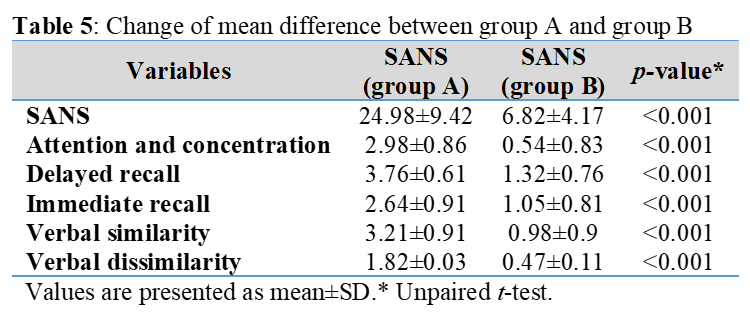
Background: People with schizophrenia usually present with deficits of several neurocognitive domains—including attention, processing speed, working memory, verbal and visual memory, and executive function. Pharmacological treatment options are limited for both negative and cognitive symptoms. However, several non-pharmacological interventions, like yoga, have been tried with evidence of effectiveness in providing measurable cognitive gains and improving negative symptoms. Objective: To find out the effect of yoga on negative and cognitive symptoms through a randomized controlled trial. Methods: A single-blind randomized controlled trial was conducted at a tertiary care hospital from June 2023 to June 2025. Patients were screened with the PANSS scale, and scores <75 were included for the study. The sample size was calculated as 104. Two groups were formed with 60 participants in each group randomly: Group A, with patients who were given yoga intervention along with standard pharmacotherapy, and Group B, with patients who continued with the standard pharmacotherapy (olanzapine up to 30mg). Baseline PGIBBD and CTT scores were obtained from each participant at baseline and after the yoga intervention. Results: After 3 months of intervention, Group A showed a marked and statistically significant reduction in symptom severity, with substantial improvements observed in both negative and cognitive symptom domains as measured by SANS scores, PGIBBD, and CTT scores. Conclusions: The concurrent improvement in both symptom severity and cognitive measures in the yoga intervention group addresses not only clinical symptoms but also associated cognitive deficits, which are critical determinants of functional outcome.
Downloads
References
First MB, Gaebel W, Maj M, Stein DJ, Kogan CS, Saunders JB, et al. An organization- and category-level comparison of diagnostic requirements for mental disorders in ICD-11 and DSM-5. World Psychiatr. 2021;20: 34–51. doi: 10.1002/wps.20825. DOI: https://doi.org/10.1002/wps.20825
Rao NP, Ramachandran P, Jacob A, Joseph A, Thonse U, Nagendra B, et al. Add on yoga treatment for negative symptoms of schizophrenia: a multi-centric, randomized controlled trial. Schizophr Res. 2021;231:90–97. doi: 10.1016/j.schres.2021.03.021. DOI: https://doi.org/10.1016/j.schres.2021.03.021
Rubio JM, Schoretsanitis G, John M, Tiihonen J, Taipale H, Guinart D, et al. Psychosis relapse during treatment with long-acting injectable antipsychotics in individuals with schizophrenia-spectrum disorders: an individual participant data meta-analysis. Lancet Psychiatr. 2020;7(9):749-761.doi: 10.1016/ S2215-0366(20)30248-0. DOI: https://doi.org/10.1016/S2215-0366(20)30264-9
Dickinson D, Goldberg TE, Gold JM, Elvevåg B, Weinberger DR. Cognitive factor structure and invariance in people with schizophrenia, their unaffected siblings, and controls. Schizophr Bull. 2011;37:1157–1167. doi: 10.1093/schbul/sbq018. DOI: https://doi.org/10.1093/schbul/sbq018
Galderisi S, Rucci P, Mucci A, Rossi A, Rocca P, Bertolino A, et al. The interplay among psychopathology, personal resources, context-related factors and real-life functioning in schizophrenia: stability in relationships after 4 years and differences in network structure between recovered and non-recovered patients. World Psychiatr. 2020;19:81–91. doi: 10.1002/wps.20700. DOI: https://doi.org/10.1002/wps.20700
Spaulding WD, Sullivan ME. Treatment of cognition in the schizophrenia spectrum: the context of psychiatric rehabilitation. Schizophr Bull. 2016;42(suppl_1):S53-61. doi: 10.1093/schbul/sbv163. DOI: https://doi.org/10.1093/schbul/sbv163
Harvey PD, Bosia M, Cavallaro R, Howes OD, Kahn RS, Leucht S, et al. Cognitive dysfunction in schizophrenia: An expert group paper on the current state of the art. Schizophr Res Cogn. 2022;29:100249. doi: 10.1016/j.scog.2022.100249. DOI: https://doi.org/10.1016/j.scog.2022.100249
Maj M, van Os J, De Hert M, Gaebel W, Galderisi S, Green MF, et al. The clinical characterization of the patient with primary psychosis aimed at personalization of management. World Psychiatr. 2021;20:4–33. doi: 10.1002/wps.20809. DOI: https://doi.org/10.1002/wps.20809
Verma M, Bhargav H, Varambally S, Raghuram N, Bn G. Effect of integrated yoga on anti-psychotic induced side effects and cognitive functions in patients suffering from schizophrenia. J Complement Integrative Med. 2019;16(1):20170155. doi: 10.1515/jcim-2017-0155. DOI: https://doi.org/10.1515/jcim-2017-0155
Luders E, Toga AW, Lepore N, Gaser C. The underlying anatomical correlates of long-term meditation: larger hippocampal and frontal volumes of gray matter. Neuroimage. 2009;45(3):672-678. doi: 10.1016/j.neuroimage.2008.12.061. DOI: https://doi.org/10.1016/j.neuroimage.2008.12.061
Hopewell S, Chan AW, Collins GS, Hróbjartsson A, Moher D, Schulz KF, et al. CONSORT 2025 statement: updated guideline for reporting randomised trials. Lancet. 2025;405(10489):1633-1640. doi: 10.1016/ S0140-6736(25)00672-5. DOI: https://doi.org/10.1016/S0140-6736(25)00672-5
Minas I, Stuart GW, Klimidis S, Jackson HJ, Singh BS, Copolov DL. Positive and negative symptoms in the psychoses: multidimensional scaling of SAPS and SANS items. Schizophr Res. 1992;8(2):143-156. doi: 10.1016/0920-9964(92)90031-Y. DOI: https://doi.org/10.1016/0920-9964(92)90031-Y
Pershad D, Verma SK. Hand-book of PGI battery of brain dysfunction (PGI-BBD). National Psychological Corporation; 1990.
Gaudreau AS, Macoir J, Hudon C. Normative data for the Color Trails Test in middle-aged and elderly Quebec-French people. Appl Neuropsychol Adult. 2025;32(1):116-124. doi: 10.1080/23279095.2022.2156291. DOI: https://doi.org/10.1080/23279095.2022.2156291
Moonaz S, Nault D, Cramer H, Ward L. CLARIFY 2021: explanation and elaboration of the Delphi-based guidelines for the reporting of yoga research. BMJ Open. 2021;11(8):e045812. doi: 10.1136/ bmjopen-2020-045812. DOI: https://doi.org/10.1136/bmjopen-2020-045812
Visceglia E, Lewis S. Yoga therapy as an adjunctive treatment for schizophrenia: a randomized, controlled pilot study. J Alternat Complement Med. 2011;17(7):601-607. doi: 10.1089/acm.2010.0075. DOI: https://doi.org/10.1089/acm.2010.0075
Govindaraj R, Varambally S, Rao NP, Venkatasubramanian G, Gangadhar BN. Does yoga have a role in schizophrenia management? Curr Psychiatr Rep. 2020;22(12):78. doi: 10.1007/s11920-020-01199-4. DOI: https://doi.org/10.1007/s11920-020-01199-4
Varambally S, Holla B, Venkatasubramanian G, Mullapudi T, Raj P, Shivakumar V, et al. Clinical effects of a yoga-based intervention for patients with schizophrenia—A six-month randomized controlled trial. Schizophr Res. 2024;269:144-151. doi: 10.1016/j.schres.2024.05.007. DOI: https://doi.org/10.1016/j.schres.2024.05.007
Firth J, Stubbs B, Rosenbaum S, Vancampfort D, Malchow B, Schuch F, et al. Aerobic exercise improves cognitive functioning in people with schizophrenia: a systematic review and meta-analysis. Schizophr Bull. 2017;43(3):546-556. doi: 10.1093/schbul/sbw115. DOI: https://doi.org/10.1093/schbul/sbw115
Mullapudi T, Debnath M, Govindaraj R, Raj P, Banerjee M, Varambally S. Effects of a six-month yoga intervention on the immune-inflammatory pathway in antipsychotic-stabilized schizophrenia patients: A randomized controlled trial. Asian J Psychiatr. 2023;86:103636. doi: 10.1016/j.ajp.2023.103636. DOI: https://doi.org/10.1016/j.ajp.2023.103636
Downloads
Published
How to Cite
Issue
Section
License
Copyright (c) 2026 Al-Rafidain Journal of Medical Sciences ( ISSN 2789-3219 )

This work is licensed under a Creative Commons Attribution-NonCommercial-ShareAlike 4.0 International License.
Published by Al-Rafidain University College. This is an open access journal issued under the CC BY-NC-SA 4.0 license (https://creativecommons.org/licenses/by-nc-sa/4.0/).