Evaluation of SATB2 Expression and Its Relationship with Cyclin D1 and βHCG in Colorectal Carcinoma
DOI:
https://doi.org/10.54133/ajms.v10i1.2724Keywords:
β-HCG, Cyclin-D1 , Colorectal carcinoma , SATB2Abstract
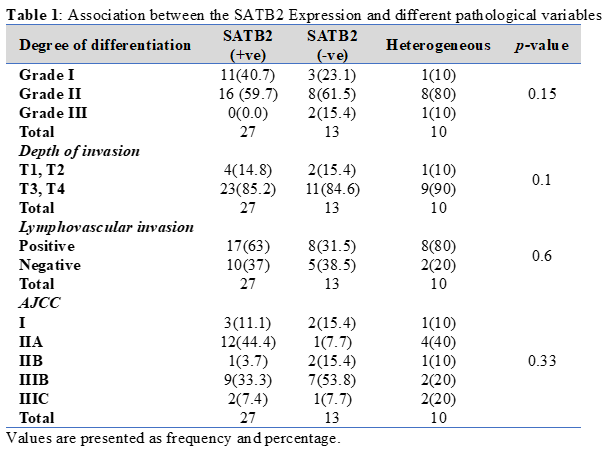
Background: Different immunostain markers have improved the early diagnosis of cancer, facilitating early-stage treatment. One of these stains was the special AT-rich sequence-binding protein-2 (SATB2), which serves as a diagnostic marker, and its expression may offer prognostic and predictive insights. Objectives: To evaluate the immunohistochemical expression of SATB2 in colorectal carcinoma cases and its relationship with some clinicopathological parameters and its expression with the expression of each β-hCG and Cyclin D1. Methods: This retrospective case series study examined fifty paraffin-embedded blocks of colorectal carcinoma from October 2024 to August 2025 that were collected from Al-Jamhuri Teaching Hospital and some private laboratories in Mosul City, which had already been studied by immunostains of β-hCG and Cyclin D1. Investigation of SATB2 by immunohistochemistry was done. Results: SATB2 was detected in 54% of the cases, mostly in individuals older than 50 years (88.9%). Grade II differentiation is found in 59.2% of these cases, while depth of invasion at the level of T3 and T4 is 85.1%, and lymphovascular invasion constitutes 62.9%. Expression of negative lymph node involvement was observed in 59.3% of cases, with 48.1% of patients at stage II; among the positive cases of SATB2, 85.1% showed high expression of cyclin D1, while 59.2% showed positive β-hCG expression. Conclusions: SATB2 is expressed in 54% of cases in patients over 50 years old, females, and Grade II. SATB2 is strongly associated with the high expression of cyclin D1 and, to a lesser extent, with β-hCG expression.
Downloads
References
Marcellinaro R, Spoletini D, Grieco M, Avella P, Cappuccio M, Troiano R, et al. Colorectal cancer: Current updates and future perspectives. J Clin Med. 2024;13(1):40. doi: 10.3390/jcm13010040. DOI: https://doi.org/10.3390/jcm13010040
Massagué J, Obenauf AC. Metastatic colonization by circulating tumour cells. Nature. 2016;529(7586):298-306. doi: 10.1038/nature17038. DOI: https://doi.org/10.1038/nature17038
Berg KB, Schaeffer DF. SATB2 as an immunohistochemical marker for colorectal adenocarcinoma: a concise review of benefits and pitfalls. Arch Pathol Lab Med. 2017;141(10):1428–1433. doi: 10.5858/arpa.2016-0243-RS. DOI: https://doi.org/10.5858/arpa.2016-0243-RS
Kowalczyk AE, Śliwińska-Jewsiewicka A, Kraziński BE, Piotrowska A, Grzegrzółka J, Godlewski J, et al. Reduced expression of SATB2 in colorectal cancer and its association with demographic and clinicopathological parameters. Int J Mol Sci. 2025;26(5):2374. doi: 10.3390/ijms26052374. DOI: https://doi.org/10.3390/ijms26052374
Magnusson K, de Wit M, Brennan DJ, Johnson LB, McDermott U, Kelly G, et al. SATB2 in combination with cytokeratin 20 identifies over 95% of all colorectal carcinomas. Am J Surg Pathol. 2011;35(7):937–948. doi: 10.1097/PAS.0b013e31821c3dae. DOI: https://doi.org/10.1097/PAS.0b013e31821c3dae
Uhlén M, Fagerberg L, Hallström BM, Lindskog C, Oksvold P, Mardinoglu A, et al. Tissue-based map of the human proteome. Science. 2015;347(6220):1260419. doi: 10.1126/science.1260419. DOI: https://doi.org/10.1126/science.1260419
Dragomir A, de Wit M, Johansson C, Uhlen M, Pontén F, Micke P, et al. The role of SATB2 as a diagnostic marker for tumors of colorectal origin: Results of a pathology-based clinical prospective study. Am J Clin Pathol. 2014;141(5):630–638. doi: 10.1309/AJCPX4CWA1B7MSGV. DOI: https://doi.org/10.1309/AJCPWW2URZ9JKQJU
Eberhard J, Gaber A, Wangefjord S, Nodin B, Uhlén M, Ericson Lindquist K, et al. A cohort study of the prognostic and treatment predictive value of SATB2 expression in colorectal cancer. Br J Cancer. 2012;106(5):931–938. doi: 10.1038/bjc.2012.34. DOI: https://doi.org/10.1038/bjc.2012.34
Schmitt M, Silva M, Konukiewitz B, Lang C, Steiger K, Halfter K, et al. Loss of SATB2 occurs more frequently than CDX2 loss in colorectal carcinoma and identifies particularly aggressive cancers in high-risk subgroups. Cancers (Basel). 2021;13(24):6177. doi: 10.3390/cancers13246177. DOI: https://doi.org/10.3390/cancers13246177
Cígerová V, Adamkov M, Drahošová S, Grendár M. Immunohistochemical expression and significance of SATB2 protein in colorectal cancer. Ann Diagn Pathol. 2021;52:151731. doi: 10.1016/j.anndiagpath.2021.151731. DOI: https://doi.org/10.1016/j.anndiagpath.2021.151731
Suvaitha M, Anand CD, John JJ. Immunohistochemical expression profile of SATB2 in colorectal adenocarcinoma and association with clinicopathological parameters. J Clin Diagn Res. 2023;17(3):EC31–EC36. doi: 10.7860/JCDR/2023/61268/17685. DOI: https://doi.org/10.7860/JCDR/2023/61268.17685
Azeez RA, Al-Jowari SA, Mahmood HJ. Comparing the expression of CDX2 and SATB2 in samples of Iraqi patients with colorectal cancer. Iraqi J Sci. 2024;65(12):6862–6873. doi: 10.24996/ijs.2024.65.12.6.1
Al-Omar Z, Mohammed B, Fadhil M. Immunohistochemical evaluation of SATB2 expression in colorectal carcinoma in Mosul City, Iraq. Al Anbar Med J. 2024;10. doi: 10.33091/amj.2024.148426.1685. DOI: https://doi.org/10.33091/amj.2024.148426.1685
Zhang YJ , Chen JW, He XS, Zhang HZ, Ling YH, Wen JH, et al. SATB2 is a promising biomarker for identifying a colorectal origin for liver metastatic adenocarcinomas. eBioMedicine. 2018;28:62–69. doi: 10.1016/j.ebiom. DOI: https://doi.org/10.1016/j.ebiom.2018.01.001
Coolbaugh-Murphy MI, Xu J, Ramagli LS, Brown BW, Siciliano MJ. Microsatellite instability (MSI) increases with age in normal somatic cells. Mech Ageing Dev. 2005;126(10):1051-1059. doi: 10.1016/j.mad.2005.06.005. DOI: https://doi.org/10.1016/j.mad.2005.06.005
Liu F, Gao Z, Shen D, Zhao H, Wang C, Ye Y, et al. Significance of SATB2 expression in colon cancer and its differential diagnosis in digestive tract adenocarcinoma and ovarian primary and metastatic carcinoma. Pathol Res Pract. 2019;215(7):152430. doi: 10.1016/j.prp.2019.04.022. DOI: https://doi.org/10.1016/j.prp.2019.04.022
Gu J, Wang G, Liu H, Xiong C. SATB2 targeted by methylated miR-34c-5p suppresses proliferation and metastasis attenuating the epithelial–mesenchymal transition in colorectal cancer. Cell Prolif. 2018;51(4):e12455. doi: 10.1111/cpr.12455. DOI: https://doi.org/10.1111/cpr.12455
Eldeeb S, Salem M, Morsi D, Soliman N. Immunohistochemical expression of SATB2 and clinicopathological correlation in colorectal adenocarcinoma. Merit Res J Med Med Sci. 2022;10:115–124. doi: 10.5281/zenodo.6478609.
Zheng H, An M, Luo Y, Diao X, Zhong W, Pang M, et al. PDGFRα⁺ITGA11⁺ fibroblasts foster early-stage cancer lymphovascular invasion and lymphatic metastasis via ITGA11-SELE interplay. Cancer Cell. 2024;42(3):377–393. doi: 10.1016/j.ccell.2024.02.002. DOI: https://doi.org/10.1016/j.ccell.2024.02.002
Shokery SEM, Moustafa WI, Daoud SA, Ahmed MM. The evaluation of SATB2 as a diagnostic immunohistochemical marker of colorectal adenocarcinoma in comparison with non-colorectal adenocarcinomas. J Pharm Negat Results. 2023;14(2):2280–2289. doi: 10.47750/pnr.2023.14.02.278.
Salem AM, Elfeky MA, Nawar N, Alattar AZ, Elekiabi OA, Elaidy MM. Prognostic value of combined COX-2, cyclin D1 and P21 expression in colorectal cancer (CRC) patients: an immunohistochemical study. Open J Pathol. 2018;8(3):145–162. doi: 10.4236/ojpathology.2018.83013. DOI: https://doi.org/10.4236/ojpathology.2018.83013
Bahnassy AA, Zekri ARN, El-Houssini S, El-Shehaby AM, Mahmoud MR, Abdallah S. et al. Cyclin A and cyclin D1 as significant prognostic markers in colorectal cancer patients. BMC Gastroenterol. 2004;4:22. doi: 10.1186/1471-230X-4-22. DOI: https://doi.org/10.1186/1471-230X-4-22
Ogino S, Nosho K, Irahara N, Kure S, Shima K, Baba Y, et al. A cohort study of cyclin D1 expression and prognosis in 602 colon cancer cases. Clin Cancer Res. 2009;15(13):4431–4438. doi: 10.1158/1078-0432.CCR-08-3330. DOI: https://doi.org/10.1158/1078-0432.CCR-08-3330
Li J, Yin M, Song W, Cui F, Wang W, Wang S, et al. B subunit of human chorionic gonadotropin promotes tumor invasion and predicts poor prognosis of Early-Stage colorectal cancer. Cell Physiol Biochem. 2018;45(1):237-249. doi: 10.1159/000486770. DOI: https://doi.org/10.1159/000486770
Bassam A, Raafat Y, Al-Aziz A, Mostafa R. Immunohistochemical expression of HCG-β in colorectal carcinoma. Open Access Maced J Med Sci. 2021;9:789–797. doi: 10.3889/oamjms.2021.6854. DOI: https://doi.org/10.3889/oamjms.2021.6854
Joung JG, Oh BY, Hong HK, Al-Khalidi H, Al-Alem F, Lee HO, et al. Tumor heterogeneity predicts metastatic potential in colorectal cancer. Clin Cancer Res. 2017;23(23):7209-7216. doi: 10.1158/1078-0432.CCR-17-0306. DOI: https://doi.org/10.1158/1078-0432.CCR-17-0306
Jun SY, Kim J, Yoon N, Maeng LS, Byun JH. Prognostic potential of cyclin D1 expression in colorectal cancer. J Clin Med. 2023;12(2):572. doi: 10.3390/jcm12020572. DOI: https://doi.org/10.3390/jcm12020572
Downloads
Published
How to Cite
Issue
Section
License
Copyright (c) 2026 Al-Rafidain Journal of Medical Sciences ( ISSN 2789-3219 )

This work is licensed under a Creative Commons Attribution-NonCommercial-ShareAlike 4.0 International License.
Published by Al-Rafidain University College. This is an open access journal issued under the CC BY-NC-SA 4.0 license (https://creativecommons.org/licenses/by-nc-sa/4.0/).