Serum Neurofilament Light Chain as an Independent Biomarker of Axonal Damage of Psychiatric Burden in Multiple Sclerosis
DOI:
https://doi.org/10.54133/ajms.v10i2.2675Keywords:
Anxiety, Biomarkers, Depression, Expanded Disability Status Scale (EDSS), Multiple sclerosis, Neurofilament light chainAbstract
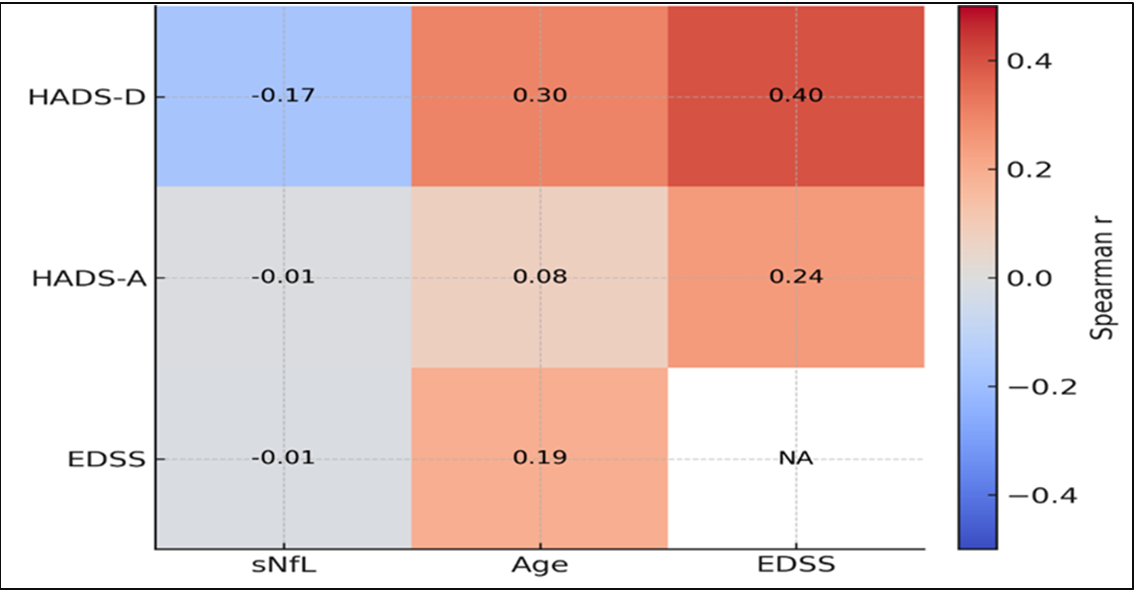
Background: Multiple sclerosis (MS) is a chronic neuroinflammatory disorder associated with neurological disability and psychiatric comorbidity. Serum neurofilament light chain (sNfL) is a biomarker of axonal injury, yet its relationship with psychiatric symptoms in MS is unclear. Objective: To assess depression and anxiety prevalence in Iraqi MS patients and the associations with sNfL. Methods: A cross-sectional case–control study was conducted at the MS Consultation Clinic, Iraqi Medical City, Baghdad (October 2024–January 2025). Depression and anxiety were evaluated with the Hospital Anxiety and Depression Scale (HADS), disability with the Expanded Disability Status Scale (EDSS), and sNfL with Enzyme-Linked Immunosorbent Assay (ELISA). Results: A total of 150 MS patients and 50 healthy subjects (controls) were enrolled. Depression and anxiety were evaluated with the Hospital Anxiety and Depression Scale (HADS), disability with the Expanded Disability Status Scale (EDSS), and serum NfL with ELISA. MS patients had significantly higher depression (31.3%) and anxiety (14.7%) than controls (4.0% and 10.0%; p<0.001). Depression correlated with lower socioeconomic and educational status, while female sex and marital status predicted higher anxiety. Median sNfL levels were elevated in MS (169.6 vs. 98.9 pg/mL; p<0.001) but showed only a weak negative correlation with depression (r= –0.174, p=0.034). Conclusions: Depression and anxiety are prevalent in Iraqi MS patients and strongly linked to sociodemographic and disability measures. While NfL, as a marker of axonal injury, had limited value for detecting psychiatric comorbidity, emphasizing the need for integrated neurological and mental health care.
Downloads
References
the development of multiple aclerosis. Al Mustansiriyah J Pharm Sci. 2021;21(3):7-15. doi: 10.32947/ajps.v21i3.792. DOI: https://doi.org/10.32947/ajps.v21i3.792
Hassoun HK, Al-Mahadawi A, Sheaheed NM, Sami SM, Jamal A, Allebban Z. Epidemiology of multiple sclerosis in Iraq: retrospective review of 4355 cases and literature review. Neurol Res. 2022;44(1):14-23. doi: 10.1080/01616412.2021.1952511. DOI: https://doi.org/10.1080/01616412.2021.1952511
Balasooriya NN, Elliott TM, Neale RE, Vasquez P, Comans T, Gordon LG. The association between vitamin D deficiency and multiple sclerosis: An updated systematic review and meta-analysis. Mult Scler Relat Disord. 2024;90:105804. doi: 10.1016/j.msard.2024.105804. DOI: https://doi.org/10.1016/j.msard.2024.105804
Abbas RS, Abdulridha MK, Shafek MA. Clinical evaluation of potential anti-inflammatory effect of Vitamin D3 adjuvant therapy for chronic asthma in iraqi patients. Int J Pharm Pharm Sci. 2017;9(1):139-144. doi: 10.22159/ijpps.2017v9i1.15546. DOI: https://doi.org/10.22159/ijpps.2017v9i1.15487
Yahya AA, Abdulridha MK, Al-Rubuyae BJ, Al-Atar HA. The effect of vitamin D and co-enzyme Q10 replacement therapy on hormonal profile and ovulation statusin women with clomiphene citrate resistant polycystic ovary syndrome. J Pharm Sci Res. 2019;11(1):208-215. doi: 10.32947/ajps.v18i2.488. DOI: https://doi.org/10.32947/ajps.v18i2.488
Iaquinto S, Ineichen BV, Salmen A, Kuhle J, Benkert P, Hofer L, et al. Factors associated with low health-related quality of life in persons with multiple sclerosis: A quantile-based segmentation approach. PLoS One. 2024;19(11):e0312486. doi: 10.1371/journal.pone.0312486. DOI: https://doi.org/10.1371/journal.pone.0312486
Peres DS, Rodrigues P, Viero FT, Frare JM, Kudsi SQ, Meira GM, et al. Prevalence of depression and anxiety in the different clinical forms of multiple sclerosis and associations with disability: A systematic review and meta-analysis. Brain Behav Immun Health. 2022;24:100484. doi: 10.1016/j.bbih.2022.100484. DOI: https://doi.org/10.1016/j.bbih.2022.100484
Inanc Y, Kaya T. Psychiatric disorders in multiple sclerosis. J Mult Scler Res. 2022;2(2):31-35. doi: 10.4274/jmsr.galenos.2022.2022-4-2. DOI: https://doi.org/10.4274/jmsr.galenos.2022.2022-8-1
Șerban M, Toader C, Covache-Busuioc RA. Brain tumors, AI and psychiatry: Predicting tumor-associated psychiatric syndromes with machine learning and biomarkers. Int J Mol Sci. 2025;26(17):8114. doi: 10.3390/ijms26178114. DOI: https://doi.org/10.3390/ijms26178114
Hagberg L, Zetterberg H, Gisslén M. Neurofilament light chain as a biomarker for neuronal injury in CNS infections. Expert Rev Mol Diagn. 2025;25(1):1-6. doi: 10.1080/14737159.2024.2354782. DOI: https://doi.org/10.1080/14737159.2025.2509023
Salem IA, Abdulsattar SA, Alrubaye HF. Neurofilament light chain assessment in type 2 diabetic patients with distal symmetrical polyneuropathy. Al Mustansiriyah J Pharm Sci. 2025;25(1):1-14. doi: 10.32947/ajps.v25i1.1114. DOI: https://doi.org/10.32947/ajps.v25i1.1122
Chen MH, Liu YL, Kuo HW, Tsai SJ, Hsu JW, Huang KL, et al. Neurofilament light chain is a novel biomarker for major depression and related executive dysfunction. Int J Neuropsychopharmacol. 2022;25(2):99-105. doi: 10.1093/ijnp/pyab065. DOI: https://doi.org/10.1093/ijnp/pyab068
Tauil CB, Rocha-Lima AD, Ferrari BB, Silva FM, Machado LA, Ramari C, et al. Depression and anxiety disorders in patients with multiple sclerosis: association with neurodegeneration and neurofilaments. Braz J Med Biol Res. 2021;54(3):e10428. doi: 10.1590/1414-431X202010428.
Syk M, Tornvind E, Gallwitz M, Fällmar D, Amandusson Å, Rothkegel H, et al. An exploratory study of the damage markers NfL, GFAP, and t-Tau, in cerebrospinal fluid and other findings from a patient cohort enriched for suspected autoimmune psychiatric disease. Transl Psychiatry. 2024;14(1):304. doi: 10.1038/s41398-024-03014-4.
Thompson AJ, Banwell BL, Barkhof F, Carroll WM, Coetzee T, Comi G, et al. Diagnosis of multiple sclerosis: 2017 revisions of the McDonald criteria. Lancet Neurol. 2018;17(2):162-173. doi: 10.1016/S1474-4422(17)30470-2. DOI: https://doi.org/10.1016/S1474-4422(17)30470-2
Wu Y, Levis B, Sun Y, He C, Krishnan A, Neupane D, et al. Accuracy of the hospital anxiety and depression scale depression subscale (HADS-D) to screen for major depression: systematic review and individual participant data meta-analysis. BMJ. 2021;373:n972. doi: 10.1136/bmj.n972. DOI: https://doi.org/10.1136/bmj.n972
Terkawi AS, Tsang S, AlKahtani GJ, Al-Mousa SH, Al Musaed S, AlZoraigi US, et al. Development and validation of Arabic version of the Hospital Anxiety and Depression Scale. Saudi J Anaesth. 2017;11(Suppl 1):S11-S18. doi: 10.4103/sja.SJA_43_17. DOI: https://doi.org/10.4103/sja.SJA_43_17
Kurtzke JF. Neurologic impairment in multiple sclerosis and the disability status scale. Acta Neurol Scand. 1970;46(4-5):493-512. doi: 10.1111/j.1600-0404.1970.tb05637.x. DOI: https://doi.org/10.1111/j.1600-0404.1970.tb05808.x
Cohen J. Statistical power analysis for the behavioral sciences. Routledge. 2013. doi: 10.4324/9780203771587. DOI: https://doi.org/10.4324/9780203771587
Faul F, Erdfelder E, Buchner A, Lang AG. Statistical power analyses using G* Power 3.1: Tests for correlation and regression analyses. Behav Res Methods. 2009;41(4):1149-1160. doi: 10.3758/BRM.41.4.1149. DOI: https://doi.org/10.3758/BRM.41.4.1149
Young CA, Langdon D, Rog D, Chhetri SK, Tanasescu R, Kalra S, et al. Prevalence, treatment and correlates of depression in multiple sclerosis. Mult Scler Relat Disord. 2024;87:105648. doi: 10.1016/j.msard.2024.105648. DOI: https://doi.org/10.1016/j.msard.2024.105648
Zhang X, Song Y, Wei Z, Chen X, Zhuang X, Yi L. The prevalence and risk factors of anxiety in multiple sclerosis: A systematic review and meta-analysis. Front Neurosci. 2023;17:1120541. doi: 10.3389/fnins.2023.1120541. DOI: https://doi.org/10.3389/fnins.2023.1120541
Alswat AM, Altirkistani BA, Alserihi AR, Baeshen OK, Alrushid ES, Alkhudair J, et al. The prevalence of major depression and generalized anxiety disorder in patients with multiple sclerosis in Saudi Arabia: a cross-sectional multicentered study. Front Psychiatry. 2023;14:1195101. doi: 10.3389/fpsyt.2023.1195101. DOI: https://doi.org/10.3389/fpsyt.2023.1195101
Alharbi NA, Alawi SH, Alharbi YM, Alharbi MY, Alsamarh TN, Aldubaiyan AA, et al. Prevalence of depression and anxiety among adult patients with multiple sclerosis at Riyadh City, Saudi Arabia. Neurosciences (Riyadh). 2022;27(2):71-78. doi: 10.17712/nsj.2022.2.20210116. DOI: https://doi.org/10.17712/nsj.2022.2.20210101
Bahathig A, Alblowi MA, Alhilali AA, AlJasim BS, Alhelow M, Aldakheel H, et al. The prevalence and association of depression and anxiety with multiple sclerosis in Riyadh, Saudi Arabia: a cross-sectional study. Cureus. 2020;12(12):e12133. doi: 10.7759/cureus.12133. DOI: https://doi.org/10.7759/cureus.12389
Ghahremani A, Mosa Farkhani S, Baniasadi M, Hojjat SK, Namdar Ahmadabad H, Salarbashi D, et al. Personality traits of patients with multiple sclerosis and their correlation with anxiety and depression levels: A cross-sectional case–control study. Brain Behav. 2022;12(5):e2596. doi: 10.1002/brb3.2596. DOI: https://doi.org/10.1002/brb3.2596
Alqahtani A, Alhusseini N, AlHusseini N. Assessing social determinants of health among patients with depression at primary healthcare centers in Riyadh City. Cureus. 2023;15(11):e48813. doi: 10.7759/cureus.48813. DOI: https://doi.org/10.7759/cureus.48854
Jespersen A, Madden R, Whalley HC, Reynolds R, Lawrie SM, McIntosh AM, et al. Socioeconomic status and depression–A systematic review. medRxiv. 2023. doi: 10.1101/2023.01.24.23284949. DOI: https://doi.org/10.1101/2023.12.04.23299380
Alhabeeb AA, Al-Duraihem RA, Alasmary S, Alkhamaali Z, Althumiri NA, BinDhim NF. National screening for anxiety and depression in Saudi Arabia 2022. Front Public Health. 2023;11:1213851. doi: 10.3389/fpubh.2023.1213851. DOI: https://doi.org/10.3389/fpubh.2023.1213851
Saied AA, Ahmed SK, Metwally AA, Aiash H. Iraq's mental health crisis: a way forward? Lancet. 2023;402(10409):1235-1236. doi: 10.1016/S0140-6736(23)01550-X. DOI: https://doi.org/10.1016/S0140-6736(23)01283-7
Sulaiman WY, Ali SK. Prevalence of depression among patients with multiple sclerosis in Erbil city. Zanco J Med Sci. 2020;24(2):246-255. doi: 10.15218/zjms.2020.029. DOI: https://doi.org/10.15218/zjms.2020.029
Shawon MSR, Hossain FB, Hasan M, Rahman MR. Gender differences in the prevalence of anxiety and depression and care seeking for mental health problems in Nepal: Analysis of nationally representative survey data. Camb Prisms Glob Ment Health. 2024;11:e46. doi: 10.1017/gmh.2024.41. DOI: https://doi.org/10.1017/gmh.2024.37
Buckman JEJ, Saunders R, Stott J, Arundell LL, O'Driscoll C, Davies MR, et al. Role of age, gender and marital status in prognosis for adults with depression: An individual patient data meta-analysis. Epidemiol Psychiatr Sci. 2021;30:e42. doi: 10.1017/S204579602100028X. DOI: https://doi.org/10.1017/S2045796021000342
Cejalvo E, Martí-Vilar M, Gisbert-Pérez J, Badenes-Ribera L. Stress as a risk factor for informal caregiver burden. Healthcare (Basel). 2025;13(7):731. doi: 10.3390/healthcare13070731. DOI: https://doi.org/10.3390/healthcare13070731
Kastaun S, Brose LS, Scholz E, Viechtbauer W, Kotz D. Mental health symptoms and associations with tobacco smoking, dependence, motivation, and attempts to quit: findings from a population survey in Germany (DEBRA study). Eur Addict Res. 2022;28(4):287-296. doi: 10.1159/000524458. DOI: https://doi.org/10.1159/000523973
Park SM, Kim DB, Joo MJ, Park EC. Association between living alone and generalized anxiety disorder in Korean adults. J Affect Disord. 2024;362:630-637. doi: 10.1016/j.jad.2024.06.096. DOI: https://doi.org/10.1016/j.jad.2024.07.112
Sullivan AB, Davis B, Kidd J, Chiong-Rivero H. Understanding depression in people living with multiple sclerosis: a narrative review of recent literature. Neurol Ther. 2025;14:1-30. doi: 10.1007/s40120-024-00688-w. DOI: https://doi.org/10.1007/s40120-025-00728-8
Buono VL, Corallo F, Bonanno L, Pria D, Di Cara M, Palmeri R, et al. Psychological symptoms in Multiple Sclerosis and the role of marital status: Results from a retrospective single-center study. Mult Scler Relat Disord. 2023;79:105051. doi: 10.1016/j.msard.2023.105051. DOI: https://doi.org/10.1016/j.msard.2023.105051
de Mol CL, Lamballais S, Muetzel R, Duijts L, Smolders J, White T, et al. Environmental multiple sclerosis (MS) risk factors, genetic MS risk, and brain development in a general paediatric population. J Neurol Neurosurg Psychiatry. 2025;96(7):679-685. doi: 10.1136/jnnp-2024-334346. DOI: https://doi.org/10.1136/jnnp-2024-335053
Tauil CB, Rocha-Lima AD, Ferrari BB, Silva FM, Machado LA, Ramari C, et al. Depression and anxiety disorders in patients with multiple sclerosis: association with neurodegeneration and neurofilaments. Braz J Med Biol Res. 2021;54(3):e10428. doi: 10.1590/1414-431x202010428. DOI: https://doi.org/10.1590/1414-431x202010428
Aktas O, Renner A, Huss A, Filser M, Baetge S, Stute N, et al. Serum neurofilament light chain: No clear relation to cognition and neuropsychiatric symptoms in stable MS. Neurol Neuroimmunol Neuroinflamm. 2020;7(6):e885. doi: 10.1212/NXI.0000000000000885. DOI: https://doi.org/10.1212/NXI.0000000000000885
Syk M, Tornvind E, Gallwitz M, Fällmar D, Amandusson Å, Rothkegel H, et al. An exploratory study of the damage markers NfL, GFAP, and t-Tau, in cerebrospinal fluid and other findings from a patient cohort enriched for suspected autoimmune psychiatric disease. Transl Psychiatry. 2024;14(1):304. doi: 10.1038/s41398-024-03014-4. DOI: https://doi.org/10.1038/s41398-024-03021-8
Gafson AR, Jiang X, Shen C, Kapoor R, Zetterberg H, Fox RJ, et al. Serum neurofilament light and multiple sclerosis progression independent of acute inflammation. JAMA Netw Open. 2022;5(2):e2147588. doi: 10.1001/jamanetworkopen.2021.47588. DOI: https://doi.org/10.1001/jamanetworkopen.2021.47588
Galetta K, Deshpande C, Healy BC, Glanz B, Ziehn M, Saxena S, et al. Serum neurofilament levels and patient‐reported outcomes in multiple sclerosis. Ann Clin Transl Neurol. 2021;8(3):631-638. doi: 10.1002/acn3.51318. DOI: https://doi.org/10.1002/acn3.51305
Hassan SS, Darwish ES, Ahmed GK, Azmy SR, Haridy NA. Relationship between disability and psychiatric outcome in multiple sclerosis patients and its determinants. Egypt J Neurol Psychiatr Neurosurg. 2023;59(1):128. doi: 10.1186/s41983-023-00728-6. DOI: https://doi.org/10.1186/s41983-023-00702-x
Seferoglu M, Koca N, Sivaci AO, Yurtogullari S. Factors associated with depression and anxiety severity in multiple sclerosis patients. J Mult Scler Res. 2021;1(3):69-74. doi: 10.4274/jmsr.galenos.2021.2021-9-1. DOI: https://doi.org/10.4274/jmsr.galenos.2022.2021-10-2
Asadollahzadeh E, Ebadi Z, Owji M, Rezaeimanesh N, Sahraian MA, Moghadasi AN. Exploring the relationship between disability status, depression, and quality of life in individuals with multiple sclerosis. Mult Scler Relat Disord. 2024;87:105629. doi: 10.1016/j.msard.2024.105629. DOI: https://doi.org/10.1016/j.msard.2024.105629
Downloads
Published
How to Cite
Issue
Section
License
Copyright (c) 2026 Al-Rafidain Journal of Medical Sciences ( ISSN 2789-3219 )

This work is licensed under a Creative Commons Attribution-NonCommercial-ShareAlike 4.0 International License.
Published by Al-Rafidain University College. This is an open access journal issued under the CC BY-NC-SA 4.0 license (https://creativecommons.org/licenses/by-nc-sa/4.0/).